So far the latter post is creating more hubbub, probably because of this:
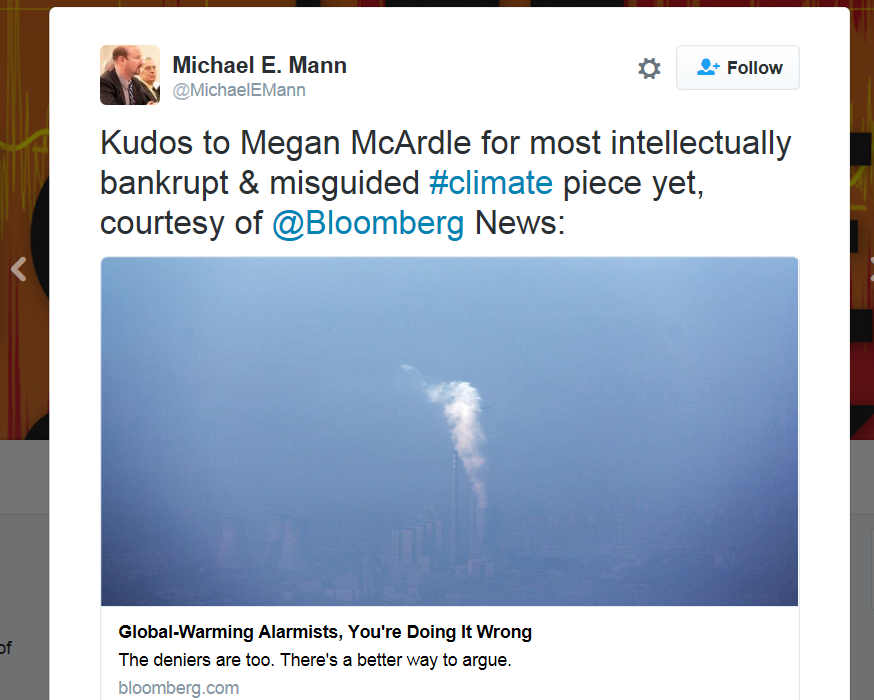


Next up: the cluster of f*ck that is her Gawker analysis.
From Newt Gingrich and the Contract with America through the spread of talk radio and Fox News to the rise of Sarah Palin, the Tea Party, and Donald Trump, the story of the Republican Party since the early 1990s is an abject lesson in the dangers of stoking populist anger and resentment — and the difficulty in controlling it once it is unleashed.
The arguments about global warming too often sound more like theology than science. Oh, the word “science” gets thrown around a great deal, but it's cited as a sacred authority, not a fallible process that staggers only awkwardly and unevenly toward the truth, with frequent lurches in the wrong direction. I cannot count the number of times someone has told me that they believe in “the science,” as if that were the name of some omniscient god who had delivered us final answers written in stone. For those people, there can be only two categories in the debate: believers and unbelievers. Apostles and heretics.As Mary McCarthy famously said, 'Every word she writes is a lie, including "and" and "the."'

In fact, there is a very long history of third parties using lawsuits to achieve public policy ends. As Eugene Kontorovich points out at the Volokh Conspiracy, if you’re a fan of legal aid societies, ACLU and civil-rights suits, or massive class action litigation, you’re a fan of third parties financing lawsuits -- often, yes, with carefully hand-picked test cases. And while much has been made of Peter Thiel’s revenge motive, it is also not unheard of for people with a personal stake in an issue to donate money to advance that cause through lawsuits. If someone who was a victim of racial oppression by the state of Mississippi later funded lawsuits aimed at fighting racism in the state, we’d be clapping, not wringing our hands.
Disclosure: My husband worked at the Competitive Enterprise Institute, which was subpoenaed, before we met, and his current employer, the Reason Foundation, was also targeted. However, the column I wrote was written before the subpoena dropped on Reason, so I only disclosed the CEI connection in the original.But I am wrong from time to time. Maybe it was the elusive butterfly of ideas, flitting hither and yon from cranium to cranium, pollinating the delicate flower of inspiration.
Peter Thiel can legitimately argue that he believes Gawker shouldn’t be allowed to publish gossip, and that he would like to advance the public interest by curbing this sort of thing through lawsuits. I disagree with his goal, as I’ve said, but it’s hard to come up with an actual principle that would justify stopping him -- other than “People I disagree with shouldn’t have the same rights as people I like.”
And that matters because -- as we so rarely seem to remember these days -- a vast, diverse country needs to be governed under broad and neutral principles. We can’t choose the winners and losers first and then jerry-rig a system that will produce the outcomes we want. Unfortunately, that’s what most people are doing when they talk about both Gawker’s journalistic standards and Peter Thiel’s lawsuits. My position on both is the same: I don’t really approve, but I also don’t see a way to stop it without endangering a lot of really important civic processes. So we’ll have to live with it.Or endangering a lot of really important sources of money.

Devin Watkins formerly worked at the Institute for Justice and graduated with honors from the Antonin Scalia Law School at George Mason University. Prior to his legal career he was a senior software developer at Intel and WebMD. In 2012, he represented Oregon at the Republican National Convention.
Less than a year ago, Kim Davis ignored a court order from the U.S. District Court for the Eastern District of Kentucky and refused to issue a marriage license to same-sex couples. She was held in contempt of court, served five days in jail, and was ruthlessly attacked in the media.
Now the office of Karl Racine, the Washington, D.C. attorney general, has ordered D.C. government employees to ignore a court order from the U.S. District Court for the District of Columbia. The order by the D.C. District Court Judge Richard Leon was to stop denying individuals applying for a concealed-carry permit from requiring a “good reason,” and to immediately update the forms to no longer require that.Watkins doesn't give a source for his scoop, which turns out to be understandable under the circumstances, which are he appears to have made the whole thing up. After the court order, Watkins said, he scurried over to get a permit for his very self. Until this moment, anyone in DC had to give a reason for wanting a gun, and not all reasons were considered to be good reasons.
After the order, I went to apply for a concealed-carry permit in the District of Columbia. The police officers there told me the D.C. attorney general’s office had ordered them to ignore the court order and continue to deny applications. Thinking there might be some kind of mistake, I contacted the AG’s office, which explicitly told me if I had a complaint about what they did I could file that complaint online.To be clear:
Update, 5/19/2016It's very odd that the AG's office would make an official announcement that they were putting the order into effect and then turn around and tell the police to ignore the order. In fact, it's unbelievable. Which is, no doubt, why the AG's office e-mailed Watkins and told him they had done no such thing.
In light of the preliminary injunction issued by Judge Richard Leon of the U.S. District Court for the District of Columbia in Grace v. District of Columbia, Civil Action No. 15-2234, the Metropolitan Police Department will not require applicants to comport with the “Good Reason” requirement under D.C. Official Code § 7-2509.11(1)(A) & (B), while the injunction is effective (see “Grace Preliminary Injunction” document, attached below).Applicants must still meet all other requirements when applying for a license to carry a concealed firearm. Applicants who were previously denied pursuant to the “Good Reason” requirement may submit a new application. The application fee for re-applicants meeting this criteria will be waived. New applicants should use the existing forms until such time as the Department is able to revise forms in accordance with the court’s order. Questions should be directed to the Firearms Registration Section at (202) 727-4275.
UPDATE: Rob Marus, communications director for the D.C. attorney general’s office, responded to this article with the following.
“[T]he Office of the Attorney General has not and would not instruct any officer of the District government to ignore any Court order. As the District stated in its reply brief filed with the Court yesterday (copy attached), the Metropolitan Police Department last week revised its concealed-carry licensing websiteBesides a correction regarding Kim Davis, at this time there have been no other additions or corrections. We don't know if Watkins contacted the police to ask them why he was told the permits were being denied. Did he talk to the person at the AG's office again to find out why she lied to him?
In a phone interview with Watkins, I got him to elaborate. The city has 90 days to consider the application, so he has not officially been denied yet. The incident occurred on May 17.
But Watkins says what the receiving officer told him—he did not get the name—strongly implied that his lack of listing the "good reason" would mean he would be denied, and that they had been told by the attorney general's office to ignore the ruling.
Watkins handed in a copy of that ruling along with his application. He does not know the name or position of the person at the attorney general's office who responded to his complaint about the matter with telling him he should just file a complaint online.
As Watkins wrote in a follow up email:
I told [the officer taking his application] “you do understand that ignoring a court order could potentially find you in contempt of court.” They said “look sir, this is not a court of law. We just do what our superiors like the AGs office order us to do.” I insisted that they take my application anyway even if they were going to deny it in the end.
The city did on May 18 write in a press release that "we believe that the District's gun laws are reasonable and necessary to ensure public safety in a dense urban area, and we will request a stay of this decision while we appeal."
But Robert Marus, a press officer for the D.C. attorney general's office, vigorously denied that they'd given any such order to disobey the order in the meantime.And what could be more convincing than a changing story with anonymous villains?
And speaking of the devil, McArdle re-tweeted Cooke's tweet. But that's not all! She also called for the resignation of Karl Racine, the AG of DC (band name!).“DC Attorney General Ignores Court Order, Refuses Gun Permits” https://t.co/UoRAsRtGQd— Charles C. W. Cooke (@charlescwcooke) May 25, 2016
Yes, a Bloomberg columnist called for the resignation of the DC AG over a dubious re-tweet.I thought Kim Davis should have resigned if she couldn’t in good conscience comply with the law. So should the DC AG https://t.co/MIO7vR64f9— Megan McArdle (@asymmetricinfo) May 25, 2016
Now for the embrace. One by one, people who had not merely resisted him before but called him by his proper name—who, until a month ago, were determined to oppose a man they rightly described as a con artist and a pathological liar—are suddenly getting on board. Columnists and magazines that a month ago were saying #NeverTrump are now vibrating with the frisson of his audacity, fawning over him or at least thrilling to his rising poll numbers and telling one another, “We can control him.’
No, you can’t. One can argue about whether to call him a fascist or an authoritarian populist or a grotesque joke made in a nightmare shared between Philip K. Dick and Tom Wolfe, but under any label Trump is a declared enemy of the liberal constitutional order of the United States—the order that has made it, in fact, the great and plural country that it already is.McArdle enthusiastically supported the #NeverTrump "movement." Gopnik insulted her and them. He pointed out they were powerless fools, without principles or spine. For that...he must die!!
Moreover, the “modern times” restriction makes it hard to generalize, simply because there just aren’t that many modern democracies around, or enough years of history to study from them.2. You cannot prove a man will be a dictator; you can only find out after he dictators over everything.
And that assumes that Trump, having taken power, would turn into a Peron or a Lenin, and not, say, just a bad president. Leave aside for now the argument over whether he has genuinely scary-dictator instincts (I see worrying signs that he does, but this is unprovable until he tries to do scary-dictator things rather than just bray about them).3. Just because armed men backed by the biggest, most deadly military in the world take over a country doesn't mean people will obey the folks threatening to kill them. McArdle knows this because FDR tried to become a dictator and he was stopped.
There are two stages to becoming a scary autocrat. First, you have to get into a position to seize power. The most traditional routes are the military (a task for which Donald Trump’s bone spurs left him tragically disqualified), or winning elected office to abolish or corrupt the electoral process. The former route has its risks, but once you’ve safely arrived in the presidential palace, it’s pretty easy to dispense with democracy, since you have all the guns. The latter route means you need the rest of government, including all the folks with guns, to go along with you.
This certainly does happen, even in countries that have been practicing democracies for a while. But it’s by no means a given. Franklin D. Roosevelt took a certain amount of constitutional liberty with his wackier notions, and when the courts pushed back, he hit on the scary idea of basically throwing out some Supreme Court justices and replacing them with others who would rubber-stamp his policies. (The phrasing was nicer than that, but this was the basic idea, and just the sort of first step that dictators like to take toward cementing themselves as Autocrat for Life). FDR’s own party rebelled, but the Supreme Court began cooperating, too.4. Dictator FDR was unsuccessful in part because the FBI would never tap a phone on the president's order, or to gain power, or protect itself from a dictator's revenge, or protect their jobs....
There’s clearly a portion of the electorate that thrills to the more authoritarian and violent parts of his message, and presumably some of those folks are in the military and the civil service. But I’m still fairly confident that the FBI is not, say, going to start tapping journalists’ phones to find out if they’re making fun of President Trump’s comb-over, or disappearing the ones who do.5. America's institutions are too strong to let a dictator take over the US.
All-out dictatorship is pretty low on the list, because American institutions do not seem weak enough to allow it.No doubt the Republican Party will stop Trump if he tries to run for office. They're a long-standing, powerful American institution.

My theory is: You don’t put ideas in peoples’ heads; they just grow there.


Until a few early polls started coming out showing Donald Trump pulling ahead of Hillary Clinton, liberals could be forgiven a certain amount of schadenfreude. After 20 years of relentless partisanship and personal attacks, the monster that Republican leaders created had broken free of its chains and was hell bent on destroying its former master.Yes, it's true that the right's followers have decided to destroy their "masters," a rather medieval way of putting the relationship between voter and candidate. McArdle never forgets the pecking order. Her authoritarian love of hierarchy drives her to create a fantasy world in which she is, by birth and by right due to merit, an elite lording it over the peasantry.
Or maybe those liberals shouldn't be forgiven so easily. I’ve been pondering these theories -- advanced by everyone from Barack Obama and Harry Reid to Bill Maher -- and the thing is, they don’t make a heck of a lot of sense. They seem to posit a Republican electorate that is, on the one hand, so malleable that the GOP leadership could create the emotional conditions for a Trump candidacy -- and on the other hand, a Republican electorate so surly and unmanageable that it has ignored the horrified pleading of conservative leaders and intellectuals, in order to rally behind Trump.McArdle has read about people who read studies on conservative authoritarianism. She complained about them in this I-know-you-are-but-what-am-I? post.
Conservatives are conservative because they're authoritarian and resistant to new ideas. Everyone knows that, right? There's a bunch of social-science research that even proves it. If only conservatives were more open and less dogmatically attached to their tribe and their traditions, the world would be a much better place. A lot of smart people endorse some version of this story. And yes, research surveys show that conservatives do express a much stronger affinity for obedience, authority and in-group loyalty than do liberals. But there's a question those surveys can't answer: How does what people say translate into what people actually do?McArdle admits conservatives are authoritarian but denies that conservatives are authoritarian but says that so is everyone else. Now, when she wants to disavow her own tribe's allegiance to the Trump buffoon, she pretends that conservatives can't be molded. If that were true she wouldn't have a job.
Perhaps because I have spent the last 15 years trying to convince other people of my opinions, I have an alternate theory. My theory is: You don’t put ideas in peoples’ heads; they just grow there. Consider the five major planks of the “Everything is the fault of the Republican Party” argument:McArdle might actually believe this. She says advertising doesn't affect people's choices and money doesn't affect politics. Naturally, she says this because she doesn't have the faintest idea where her own ideas come from. She "thinks" from the gut, having emotional reactions to stimuli and then rationalizing her response with intellectual arguments afterwards, if at all. She believes whatever satisfies her emotional needs.
1.Talk radio and Fox News made conservatives crazy. Now, I don’t particularly care for most talk radio. (There are plenty of exceptions, which can be roughly inferred from finding out which conservative talk radio shows I have appeared on.) The name calling and buzzwords are juvenile, and the level of policy debate is not high enough to hold my interest, regardless of whether I agree with some of the chatter. And blissfully freed from the necessity of actually governing, or getting elected, talk-radio folks are prone to urge counterproductive tactical extremism that is great for their ratings and terrible for the political causes they are allegedly trying to advance.The extremists are not extreme because decades of talk radio have whipped them into extremism, although talk radio has been whipping them into extremism for decades.
That said, media follows its audience, rather than leading it. Opinion columnists who spend any time at all interacting with their readers are well aware of how pitifully rarely we manage to change anyone’s mind about anything. I’m not saying that it never happens, because it does. But mostly, folks read us because they agree with us, and they enjoy having us agree with them. The best evidence that conservative media has any impact on the opinions of its audience shows that the introduction of Fox News to cable systems very slightly moved those election districts to the right -- by about the margin in a white-knuckled squeaker of an election. This can’t explain the last 10 years of electoral results or the current cycle.The strawman of "change anyone's mind" is manfully overcome and beaten, leaving the original argument sitting there like a crow on corn. Talk radio peddled anti-liberal hate and scorn, and actively drove their audience to act on their orders. But since talk radio alone did not change electoral results (she says), it did virtually nothing at all.
2.Blocking president Obama’s legislation. This theory, as advanced by Senate Minority Leader Harry Reid, holds that by relentlessly delegitimizing Obama, Republicans somehow paved the way for the rise of Trump and his “no holds barred” style of politics. Now, again, I have been pretty harsh on some of the more theatrical exhibitions of pointless political power over the last eight years. But this explanation for Trump's rise is absurd. First of all, the leadership was frantically trying to stop those folks, and was unable to because the conservative base elected hard-liners who wouldn’t cooperate. Second, as this implies, the impetus for the shutdowns and the legislative blockades came from very conservative voters in the Republican base, the kind who can swing House primary races, yet Trump’s support was strongest among moderate Republicans. You could theorize that Republican obstructionism paved the way for Trump by alienating those voters, except that there’s no evidence for this; few Trump fans seem to be wildly outraged bygreen-energy initiatives, health-care expansions or the failure to cut taxes deeper and faster. When I've asked them what they’re most mad about, it’s that the leadership seemed too cooperative with Obama on immigration reform.Actually, one of the things they are most outraged about is one of McArdle's biggest enemies: regulation.

3.Personal attacks on Democrats. This is just -- I have no words for what it is. At least, not words that can be printed in a family-friendly column. It is triple-distilled balderdash … high-test twaddle … self-congratulatory swill … nonsense on stilts. It suggests that the Republican leadership could have somehow shut down all such attacks, which would have, at the very least, involved both government censorship and flagrant violation of our nation’s campaign finance laws. And of course, it suggests that climbing further up the moral high ground would have somehow instilled a sense of shame in Trump or the folks who enjoy his outrages, a theory which has been thoroughly and conclusively disproved by the events of the last six months. Should the Republicans have been more forthright in denouncing Donald Trump’s birth certificate nonsense? Absolutely, and while they’re at it they should call their mothers more, and donate more of their personal funds to global malaria eradication. But it’s a pretty big stretch to suggest that any of these things would have somehow impinged on his popularity.Not only did the Republican elite not try to rein in Trump, they encouraged his birther accusations. They might have been able to undercut his eventual elevation to a plausible political candidate; we'll never know because they were afraid of alienating Trump's racist followers.
4.Fox News gave him so much air time. C’mon. C’mon. Every time I tuned into MSNBC or CNN, I thought I had mistakenly woken up in Hugo Chavez’s Venezuela, where television stations were legally required to air hours of the off-the-cuff ramblings of their local strongman. There is a lively debate to be had over whether the networks should have chased ratings by giving Trump a couple of billion dollars' worth of free airtime. That debate does not end in the conclusion that somehow, it’s all the fault of Fox News.It is very amusing to see conservatives blame Fox for Trump after decades of vacuous support. Fox didn't support Trump at first but they did a very fine job of whipping up their audience to help get conservatives elected. It's not all Fox's fault but they certainly helped a great deal.
5.The Southern strategy. In this theory, the original sin was the GOP’s Southern strategy, in which they cynically decided to go after the South’s angry white racist vote with a code-word-laden campaign about law and order. Eventually, this culminated in the nomination of an outspoken racist for the party leadership.
I have a somewhat more nuanced view of the Southern strategy. First of all, the idea that law and order concerns were all about appealing to Southern racists is frankly nuts; law and order concerns were mostly about appealing to voters who were appalled by the explosion of violence and disorder from the '60s to the early '90s. We can certainly argue about whether the policies enacted in response to that explosion were just, right or effective, but the idea that Republicans somehow invented this to cover up their attempt to reinvent the KKK as a major political party is just shockingly ahistorical.This little bit of offal demonstrates why McArdle is and always will be a shill. She is an agnotologist, deliberately attempting to create ignorance to advance her own welfare. It is so transparently dishonest, so "shockingly ahistorical," that I will just leave it there; smelly, bloody, and oozing with dishonesty.
And second of all, to the extent that Republicans were tapping into such sentiments, some of it was simply because with crime and welfare benefits unequally racially distributed, any party that favored tough law enforcement and was skeptical of social spending was going to appeal more to whites than to minorities, and especially to whites who had strong negative feelings about the minorities who committed a disproportionate share of the crimes and collected a disproportionate share of the poverty benefits. This makes the “Southern strategy” look more deliberate than it was; part of what we’re looking at is simply a party realignment away from regional blocs and the old business/labor split and toward ideological size-of-government and culture war fault lines. The fact that small-government policies appealed to racists doesn’t mean that this was the motivation of the folks pushing those policies.It's not that our society is racist, it's just that Blacks are inferior and violent.
Which brings me to my third point, which is that to the extent that it was deliberate, the Republican Party was chasing those voters, not leading them. The racial animus behind Jim Crow was not created by political leadership; it was often reinforced by law, but it was a culture-wide systematic bias that caused, rather than reflected, Jim Crow, and which outlived the demise of its legal manifestation. You can argue that Republicans should simply have declined to have those voters in their coalition but … how? The rest of the party really did want small-government policies for a variety of ideological and personal reasons. Were they supposed to abandon the policy positions because racists also liked them? Better shut down Planned Parenthood, then, because Margaret Sanger had some incredibly unappealing views on eugenics. (Hint: She was for it.)It's not about racism, it's about ethics in small government policy.
I don’t like the fact that there are virulent racists and anti-Semites in our electorate. I don’t know how big a percentage they compose of Trump’s support, but they are obviously some portion, because I, like other right-leaning columnists, have been enjoying a bile fountain from those folks for months. I would rather those people let go of their vile hatreds and embraced better, kinder ideas about the world and the people in it. But they’re still my fellow Americans, and they have exactly as much right as I do to have their votes count. And there’s no way to keep their preferences out of the policy process unless you’re prepared to advocate that both parties should systematically collude to disenfranchise these folks, and split the remaining vote between them. That’s both impractical and more than a little creepy.And there's nothing one can do if small government voters are racist, what are the right to do, renounce them and chase them out? That would be fascist.
So whose fault is Trump then, if not the leadership of the Republican Party and the conservative movement?McArdle actually thinks she's provided a winning argument.
I tend to think that’s a bad question. It is politics-as-novel, rather than politics-as-system. We are a large, fractious nation full of clashing interest groups and wildly differing opinions, as well as differing levels of engagement with politics. That system will often spit out results that most of us don’t like very much. Trying to ascribe those results to a person, or even a small group, is like blaming the weatherman because it’s raining, or an economist for a recession. You have selected the most visible target, not the most likely one. And, in the case of Democrats who fault Republicans for Trump, a very convenient target as well.There are no villains, the people who voted for Trump are not responsible for Trump, and the right is a party of small government, not-really-racists, and fluffy kittens.
How to Deal with Cretinous Twitter Mobs: A Bleg
[by] Kevin Drum
I'm going to venture into dangerous territory and just hope that everyone will give this a sympathetic reading. I'm not trying to shift blame or dismiss a real problem.
The problem in question is the treatment of women by men on Twitter and other social platforms. In a word (or two), there's a subset of really loathsome assholes out there who harass women mercilessly: comments about looks, about rape, about death threats, etc. etc. The best solution, of course, is to get these men to knock it off, but there's no way that will happen quickly. At best, it will take many years to leach this kind of misogyny out of the internet.
In the meantime, the problem is that this treatment causes women genuine pain and stress. I don't get anywhere near this kind of abuse, but I sometimes get a bit of it, and it's no fun. So I have at least a glimmer of what it's like.Women can handle pain and stress, they do it all the time. But the main point is true; there's no excuse for abusive Twitter behavior towards women.
So here's my question: is there any kind of relatively simple therapy that can train people not to succumb to panic attacks over Twitter mobs attacking them? I'm not talking about ignoring genuine threats, like folks posting addresses and suggesting someone should be raped. Those should go straight to the police. It's all the rest that I'd like to learn to take in stride as nothing more than the meaningless ravings of cretinous sad sacks.
So: Is there anything like this? Does anyone know a reliable method for building up a thicker skin? Sort of like the hypnosis of Peter Gibbons in Office Space, except something that actually works. I know we shouldn't have to, but sometimes it's worth it even if it's galling that we need to do it at all.Sure there is. Hire people who like to fight, not people who feel bad when someone criticizes them. Pay people who will punch back twice as hard when they are punched. And by "people" I mean women.

Say what? State lawmaker tries to add age, weight limits for strippers in Louisiana
by Heather Miller
BATON ROUGE, La. (WGNO) – A state representative proposed – then pulled – a measure in the state House Wednesday that would have required strippers in Louisiana to be no older than 28 and weigh no more than 160 pounds.
Associated Press Capitol reporter Melinda Deslatte reported via Twitter that the House was discussing a bill to raise the age minimum for strippers to 21.
During the discussion, state Rep. Kenneth Havard, R-Jackson, proposed an amendment to the bill that would make it against the law for strippers to be older than 28 and weigh no more than 160 pounds.
According to Deslatte, state Rep. Julie Stokes, a Kenner Republican, was outraged by the amendment, telling her colleagues that she’s “never been more repulsed to be a part” of the Legislature.
Havard apparently pulled the amendment from discussion, and the state House unanimously approved the bill to raise the age minimum for strippers to 21. It’s headed to the governor’s desk for his signature.
He said it was a joke, though the amendment was filed and available on the Legislature' website.

"Auctioneers are licensed and regulated because they are in a position of trust that would allow an unethical individual to take advantage of both the buyers and sellers," said William Kuntz, TDLR's executive director. "That's why acting as an auctioneer without a license is a crime. And that's also why we will take whatever steps are necessary to shut down unlicensed auctioneers."Coincidentally, I recently watched the old Lovejoy tv series. In one episode Lovejoy recognized a very valuable antique while taking a one-off auctioneering job and secretly sent an employee to bid for it. He was charming but most definitely an unethical individual.
Texas is proof that limited government encourages unlimited opportunity for all. We are #1 in so many different categories, from jobs to energy to exports.
But there is more we can do to improve the business climate here in Texas.
That’s why Greg Abbott has proposed new reforms to the regulation of occupational licenses in Texas.
There are currently 150 business activities that currently require a state-issued license before they can be legally performed in Texas. Some of these are necessary for the health and safety of our citizens, like licensing medical doctors. But many are unnecessary or overly burdensome. For example, why do we require a license to be an interior designer? Or a salvage vehicle dealer? Or a “shampoo apprentice”?
We must work with the legislature to remove senseless barriers to growth, because over-regulation results in less competition, fewer choices and higher costs. It discourages those who want to start a business, and limits growth in our job market.
Greg Abbott’s new policy initiative will make it easier to do business in Texas – because the future our children inherit depends on what we do now. Read Greg Abbott’s new policy plan, Occupational Licensing, here. - See more at: https://www.gregabbott.com/making-easier-business/#sthash.u6rNkPB1.dpufIn his policy plan, we are introduced to the poor would-be auctioneer.
However, while licensure is often justified in professions that impact the health, safety, and welfare of the public (e.g. doctors, lawyers, peace officers, and engineers),. it is also frequently imposed on many professions where such concerns are absent professions(e.g. interior designers and auctioneers), imposing fees and state-‐ administered examinations. Violating licensing regulations or operating without a license often carries criminal and civil penalties.
Proponents of occupational licensing argue that licensure ensures the safety and reliability of products and services. Such claims are dubious, however. In a competitive and free market, one must always stay ahead of the next competitor or risk losing business. With some exceptions, quality, price, and availability adapt to changing market conditions. Regulation by licensure, on the other hand, results in less competition, fewer choice, higher costs, and the potential to thwart innovation. These effects are not always visible to the consumer, but they are nonetheless built-‐in costs without justification in most instances....
For instance, auctioneer Drake King was arrested of auctioning without an auctioneer's license. According to the Texas Department of Licensing and regulation, King pled guilty to the Class B Misdemeanor, was fined $500, and spent six days in jail.
When my mother retired from selling real estate, she toyed with the idea that she -- a talented cook who had long made her own croissants -- might make a little money on the side by selling homemade baked goods. It’s the sort of business that people have started from time immemorial, letting them share what they love with someone willing to pay for it.
A quick investigation, however, revealed that the thing was impossible. You can’t just bake a little stuff at home and sell it, for fear that you might poison people. If you want to poison people with your deliciously flaky homemade croissants, it must be done on a strictly ad-hoc, volunteer basis.You also can't bake a little at home and sell it and expect to make any money. You're paying retail prices for ingredients, or rather your husband is. And you really do need to prove that roaches aren't crawling over your floor or your eggs aren't stored at room temperature or dishwater doesn't splash into the food or the pans aren't washed at a temperature that won't kill germs. (In my youth I obtained a Sanitation Certificate for restaurants and hotels.)
Welcome to the modern economy, where increasingly, everything not compulsory is forbidden.Message: Occupational licensing is fascism.
We are hedged around with rules to protect us, to protect other people, to protect some theoretical victim who exists only in the minds of regulators and judges. And there’s reason to worry that this red tape is getting wrapped so tight that it risks rendering us immobile.
...
In 2012, the Institute for Justice -- a public-interest law firm advocating libertarian causes -- looked at the number of occupations that require licensing. Specifically, the institute looked at occupations typically filled by lower- and middle-income workers. These are not your airline pilots, your certified public accountants and your neurosurgeons; they’re the nations interior decorators, auctioneers and florists. (Yes, you read that right: In at least one state, these occupations cannot be practiced without a license.)Conflict of interest shout out! Although at this point, the Koches have their tentacles into some many organizations that it would be impossible for McArdle to avoid having a conflict of interest. As soon as she decided to take Koch money and Koch jobs and then hide the conflict, she became permanently compromised.
... If the entire District of Columbia regulatory apparatus vanished tomorrow, five years hence I would still feel pretty safe walking into Georgetown University Hospital, simply because the institution itself has a reputation to protect that would quickly disappear if it became known as a great place to die during routine procedures.The Free Market will solve all problems.
But most people get the shakes when you start talking about relaxing medical licensing, so let’s leave that aside. How many of the professions on the Institute for Justice's list really require licensing to protect consumers from disaster?
Not really all that many. Sure, consumers may be at risk that they’ll pay a lot of money to someone who does a bad job, and then have a hard time getting their money back. They might have to go around with an ugly haircut, or live with their imperfectly sanded floors. But as most of us can probably personally testify, licensing does not inoculate the industries against those dangers.1So what if your teeth whitener ruins your bleaching? You can always go to someone else next time. No harm done!
High street clinics are using teeth whiteners containing more than 200 times the legal level of a dangerous bleach.
The toxic levels of hydrogen peroxide were discovered after trading standards officers swooped on salons promising punters a perfect Hollywood smile.
The shock revelation comes after the Sunday Mirror told how unqualified practitioners were cashing in on the £1billion industry, putting customers’ health at risk.
Only dentists – or dental health professionals working to a dentist’s prescription – are legally allowed to carry out teeth whitening.
Yet thousands of unregistered “technicians” are providing a cut-price service in hairdressers, tanning shops, clinics and beauty salons.
Now an official investigation into 40 such outlets has revealed many are using dangerous bleaching gels which can cause blisters and gum damage.McArdle lets us know that your babysitter really doesn't need that criminal history check. Just think how much money you'll save! She explains that it's really all about income inequality ethics.
...
What these licenses are really good at is excluding competition. And in an era when we’re worried about mobility, that’s a problem.
Much as I love Silicon Valley, its cultural dominance has disastrously corrupted our sense of what entrepreneurship is. Talking about starting your own business, and too many people think the measure of success is whether you can sell the thing for at least a couple of hundred million dollars. Most entrepreneurship is considerably more humble than that; it is individuals with some talent, or a willingness to work hard, who want to sell their services to the public. They may never employ another person; they may not even work full time themselves. And these people never buy gracious mansions, or endow scholarships, or get buildings named after them. They just make their own lives a little bit better, hopefully, in the process of doing the same for their customers. We are artificially stopping that process, in order to protect insiders who already have the job.
That’s great for the insiders, who get above-average job stability and wages. But it’s terrible for the folks who are outside. And the more industries we put under the control of such regimes, the more the outsiders will show up in our economic data as people permanently stuck at the bottom.
We can do better than that. The problem is that such regimes are politically very stable, because the benefits are highly concentrated, while the costs are diffuse. Every licensed interior designer is passionately interested in shutting out unlicensed competitors, but their potential customers probably have better things to do than phone up their senators to demand to know why they can’t hire this chap they just met who has absolutely splendid taste in early Chippendale.
McArdle warns us that getting rid of licensing will be a long, hard slog but the Institute of Justice is manfully doing the hard work and as God is her witness, one day there will be no more regulation at all, for the benefit of the health, wealth, and happiness of mankind!

THE rise of Donald Trump, and with him a white-identity politics more explicit than anything America has seen in decades, has created an interesting division on the political left — over the question of what, if anything, liberal politics ought to offer to people who seem bigoted.Actually, no. Douthat is trying to switch the dialogue away from conservative racism by trolling liberals. Liberals owe bigots nothing and should offer bigots nothing. That is painfully obvious but that would be the end of Douthat's career, which is based on religious, racial, and class bigotry. But mostly racism. So Douthat must find a way to convince liberals to give racists respect and a place at the table of public opinion, instead of telling them to fuck off as they should.
On the one hand there are liberals determined to regard Trumpism as almost exclusively motivated by racial and cultural resentments, with few legitimate economic grievances complicating the morality play. From this perspective, the fact that Trump’s G.O.P. has finally consolidated, say, a once-Democratic area like Appalachia is almost a welcome relief: At last all the white racists are safely in the other party, and we don’t have to cater to them anymore.Democrats catered to racists and bigots by pushing for civil rights for all minorities and refraining from the worst of racist, sexist, and authoritarian excesses?
On the other hand, there are left-wingers who regard Trump’s support among erstwhile Democrats as a sign that liberalism has badly failed some of its natural constituents, and who fear that a Democratic coalition that easily crushes Trump without much white working-class support will simply write off their struggles as no more than the backward and bigoted deserve.No, Douthat. The "left-wingers" support Sanders. Few Democrats support Trump. The white working class stopped being the left's natural constituents a long time ago because of racism (among other reasons). Labor unions have relatively little power. The Democratic power base loathes Trump. Douthat must lie to convince people to side with racists and bigots.
That's just sad. Even when deBoer is right he manages to be wrong; no wonder Douthat quotes him. DeBoer's work is perfect for trolling liberals, so here he is.I like how the left-wing gadfly Fredrik deBoer framed this issue:
Nothing. We owe them nothing except a great big, "Fuck off."“What do you owe to people who are guilty of being wrong?” It’s a question for liberals all across the Western world to ponder, given the widening gulf between their increasingly cosmopolitan parties and an increasingly right-leaning native working class.
Who cares? Why listen to bigots when you can easily find someone who is right and not a bigot? So Ross "Fucking" Douthat can continue to make a small fortune begging and insulting and hectoring us all to be racist bigots like him?But as a conservative, I would add another question: What happens if the bigoted sometimes get things right.
We have lots of reasons to reject conservatism but bigotry is a very good place to draw the line. Fuck off, Douthat.Don’t worry, this isn’t a setup for my slow reconciliation with the candidacy of Donald Trump. Rather, it’s a warning against organizing your politics around antibigotry alone, and assuming that just because there are racists or nativists or xenophobes on the other side of a policy argument your side must be right.
Yastreblyansky covers this little snarl of misdirection and outright lying so I don't have to, although he inexplicably leaves out the "Fuck off, Ross Douthat" so essential to the Ross Douthat critical oeuvre.Here are a few pertinent examples, from the recent past to the present day.For decades following the 1960s, liberals insisted that the Republican Party’s tough-on-crime rhetoric wasn’t really about crime at all; it was a barely coded appeal to racists, a transference of white supremacist politics from “segregation now, segregation forever” to paranoia about Willie Horton.Tough-on-crime rhetoric did indeed play on racial fears; lots of white bigots did vote for law-and-order Republicans. But the rhetoric also played on fears of the actual immense crime wave sweeping the United States, a wave that liberal governance failed miserably to arrest or roll back. And for a long time, elite opinion was so determined not to give white bigots any aid and comfort, so determined not to take racists’ side in any way, that it ignored or minimized the actual policy problem, the actual crisis at its door.
Democratic elite priorities have nothing to do with whether or not Democratic followers must accept conservative racism and bigotry. They do not and will not.A second example: Both Clintonite neoliberals and free-market conservatives have long dismissed American anxieties about trade deals as the province of rubes and xenophobes, Ross Perot’s nationalists and Pat Buchanan’s nativist brigades. Which was somewhat understandable, since many people who thrilled to Mexico-bashing and, later, China-bashing — and who thrill to it today from Trump — really were bigoted or tribal, eager to find a sinister Latin or Asian scapegoat for their woes.But that tribal sentiment doesn’t ultimately tell us anything one way or another about the merits of the trade policies themselves. And today there’s increasing evidence that the tribalists were, well, right to be suspicious — that the creative destruction set in motion over their objections cost more jobs, with fewer compensating benefits, than many liberal and conservative free-traders once expected.
First Ooga, likewise, Booga! The problem is dealing with global disruptions due to war, global warming, and mis-governance. Adding racism and other bigotries will not help.Likewise with European anxieties about mass immigration, which for decades the major political parties of Europe labored to confine to the political fringe. After all, their thinking went, since the ranks of immigration skeptics included many racists and Islamophobes and crypto-fascists, the fringe is where those ideas belonged.
This racist fear-mongering should get Douthat fired. It is just as utterly reprehensible when he does it as when Trump does it.Unfortunately, some of the anxieties of the nativists proved more prescient than the blithe assumptions of the elite. Mass immigration is now destabilizing Europe’s liberal order, forging Islamist fifth columns and empowering the very nationalism that open-door cosmopolitanism thought it could safely marginalize and ignore.
Douthat is going to get my loved ones killed, just like Trump is inspiring attacks against Muslims.A final, forward-looking example: In our latest culture war battlefield, the debate over transgender rights, the left is so determined to rout bigotry that it’s locking in a contested understanding of what gender dysphoria is and how to handle it in children, backing it with federal regulatory power, and punishing with academic witch hunts experts who differ even modestly.Because bigots bully transgender teenagers, liberalism has decided that everyone who differs with transgender activists must be complicit in that bigotry. But we don’t have anywhere near enough data or experience to confirm the activist perspective — and by embracing it as the only alternative to “transphobia,” we risk sweeping a broad range of childhood fantasy and teenage confusion onto a set path of hormonal and surgical transformation.If bigots are for it, we’re against it. It’s a powerful credo. But there’s always a danger that by following it too far, you end up being against reality itself.
Inequality has emerged as a contentious issue since the financial crisis, and it figures prominently in the presidential campaigns of both political parties. Bloomberg View columnists Megan McArdle and Noah Smith try to make sense of it and figure out what, if anything, should be done.
Megan: What sort of inequality should we care about? Wealth inequality, income inequality, inequality of opportunity, inequality of mobility -- these tend to get lumped together. No amount of fair opportunity will produce similar outcomes for two different people. This tends to get ignored, because it's inconvenient for both sides.Or because it's irrelevant to the question of a system set up by the rich to benefit the rich at the expense of the poor.
So what kinds of inequality should we talk about? And what kinds should make us shrug and say, "Yeah, well, life's rough sometimes"?McArdle probably has no idea how callous she appears throughout this exchange, mostly because she is far too callous to care.
Noah: We -- policy advisers, writers, the government -- should care about what people care about. If people are upset that women soccer players get paid less than men, we should try to do something about it. If people are upset that most of the income gains over the past three decades have gone to people at the upper end of the distribution, then we should try to do something about that. Popular sentiment should be our guide here.
But there's generally a tradeoff involved -- make your society less unequal, and you might distort it in ways that also make everyone poorer. We have to balance those kinds of considerations. I'm just saying, if people care about some kind of inequality, we shouldn't ignore it.Noah must be fair because that is what decent people do in decent society, but he insists that if We The People want something, they have the right to try to get it, within boundaries.
Megan: There's a lot to agree with in that, but let me suggest a few problems. First, what does it mean to say "We should care if people are upset"? Some people ARE upset that woman soccer players make less than male soccer players. Those people probably spend a lot more time thinking about it, and being upset by it, than the vast majority of people who don't care -- and wouldn't think about it even if you told them they ought to.McArdle doesn't care about income inequality, wealthy inequality, or the shrinking of the middle class. As she said before, she only cares about the bottom rung of sustenance, which is so high, she says, that we really don't need to worry about the poor either. And if you cast your mind back to the past, you might remember that McArdle thinks sexism isn't a big problem because men are smarter than women anyway, racism isn't a problem because the free market would punish it and because blacks might be dumber anyway, and laws that eliminate privacy aren't a problem because women should feel bad about having an abortion. McArdle is extremely generous with any problem that does not affect her personally; it doesn't even exist.
Probably in 1900 most people didn't care about the grotesque inequality between whites and blacks, but we say they should have done something anyway. As an empirical description, the majority didn't care, and we didn't do much about it.Of course anyone and everyone would immediately point out that 1900 is only 35 years after the end of slavery and the Civil War and abolition movement were considerable proof that the majority did care a tremendous amount, on both sides of the issue. It is a monstrously stupid thing to say but McArdle's job is to provide monstrous excuses for monstrous acts and she takes her work seriously, although her execution is anything but serious or competent.
The other question I'd ask is whether the vast majority of folks really do care about inequality very much. I don't think they care about it in the way that upper-middle-class elites do. For them, it's always about the upper 1 percent. But most people don't care whether Warren Buffett is rich. They care that they feel shut out of their local economy.McArdle must pretend the two are not connected, of course. The laziness of her arguments is truly remarkable. Nobody cares. So what? Eh, only rich people care about the super-rich people. The poor only care about the local economy, like low wage jobs at McDonald's and J.C. Penny's and the Exxon gas station. That has nothing to do with the global economy of the rich.
Noah: First of all, let me say that most black people certainly DID care a great deal in 1900 about racial inequality. And if a policy is causing a minority a huge amount of pain, I'd say we need to deal with that.Good for you, Noah. Your humanity will be wasted on McArdle but at least you tried to get her to acknowledge the existence of anyone but herself and her personal circle.
But telling people not to care about inequality just makes the whole job harder. Telling people to "just deal with it" makes them shut up, but it doesn't make them stop caring.The whole point of McArdle's job is to make everyone else's job harder. Harder to stop pollution, harder to have workplace protection, harder to control your own body, harder to earn a decent living.
Megan: In my circles, and in my reading, virtually no one is saying we shouldn't care about inequality. Most articles on inequality are about how terrible it is, and so is most of the conversation I hear.McArdle is saying it. McArdle just said it wasn't terrible, or even a source of concern. She's so dishonestly stupid, so stupidly dishonest, that she thinks ignoring her own words is an acceptable tactic of argumentation.
But let me lay my priors on the table: 1) I don't particularly care about income inequality, and I especially don't care about the 1 percent. The 1 percent makes life a little harder for folks like me, because in a flatter income distribution, I'd be more competitive for things like bigger houses. But this isn't a very large social problem.McArdle pretends that concern about income inequality is just the greed of the upper class. She is not that greedy, she sniffs, so she doesn't care about the enormity of income inequality.
2) I do care a lot about what you might call socioeconomic hollowing out -- that is, the distance between the bottom and the middle and upper-middle class. I think that's just enormously destructive in a number of ways, starting with broad social cohesion and labor mobility.Not that we can do anything about that, of course, because institutional success is both systemic and non-systemic and the poor are poor because of their culture.
3) I am as uninterested in wealth inequality as I am in income inequality. I think the evidence that the very wealthy disproportionately affect politics and policy with their wealth is pretty slight, and I don't think it has much to do with the problems faced by folks lower in the income distribution, either. Redistributing the Walton family fortune would do little to nothing to make people better off in the long run, or even the short run.You would have to be the world's biggest moron to think that money doesn't disproportionally affect politics or sway political opinion. McArdle actually said that lobbying has no effect; I guess that like advertisement, companies and individuals spend billions for nothing.
4) I care hugely about inequality of opportunity and mobility.Yes, McArdle said that motivation and aptitude are the only way to achieve success in this, the best of all possible worlds. As I mocked before, the idea that we live in a meritocracy is ludicrous and self-refuting.
5) And I also care a great deal about something that's not income inequality, but often gets lumped into it: the basic condition of the worst-off in our society.She cares so much about the poor she denies they exist.
Noah: What you care about might not be the same as what other people care about. Just because you're not worried about the 1 percent doesn't mean that Americans as a whole think the same.Burn! You go, girl! Or guy!
One thing I care about a lot is inequality of social status.Oh, crap.
I don't like seeing some people lord it over others. My first real encounters with status disparities based on income or wealth didn't come until I moved to New York in 2012. It was really jarring to see rich people segregate themselves from poor people, refuse to date poor people, and get way more attention and respect than poor people. That increased the degree to which I cared about economic inequality. Now would government redistribution fix that? Maybe.Do you know the difference between a cool person and a not-cool person? The cool person doesn't care what others think about him. He does his own thing, sometimes happy, something less happy, but always true to himself. Cool people attract others who like to be around non-judgmental, busy, generally happy and at-peace people.
Megan: This is a really interesting point. I grew up in New York City in the 1970s, when it was much more equal. And yet there were still these vast disparities in status. Does income inequality actually drive status inequality? Or is it a proxy for other things? I doubt the head of General Electric today is more powerful and respected than the head of GE in 1955, even though the current head makes a whole lot more money.Is status dependent on wealth? Who knows? Who could ever answer such a difficult question? Or is status based on something else that we won't bother to mention, such as how much money your parents have? What a dilemma!
Noah: So what should we do about inequality? Heavy tax-based redistribution is not going to have a huge effect on status inequality. I still favor some amount of redistribution, because I don't want to see people on the bottom of the distribution in hardship. I want them to be in good health, have quality shelter and have all the nutritious food they need, as well as be able to get around their cities on public transit.That's right, Noah. Paris Hilton would have just as high a social status if she were born Pam Higgins, daughter of Sam and Marilyn Higgins, dentist and teacher respectively, of suburban Atlanta. But points to Noah for realizing the poor deserve decent lives and deserve the help of the rich. He wants them to have affordable health care, decent homes, and more than enough to eat.
In general, massive redistribution isn't going to fix the problem of status inequality. But I am appalled by the vastly greater status given to rich people in America, especially in places like New York. I want to make working-class and lower-class people feel good about themselves, in addition to having the aforementioned material security. But I don't know how to do this.Poor Noah. Let's give him a hand. The difference in status between the upper class and the grossly wealthy is directly related to the status of the poor. The poor don't care that Noah couldn't get a date with a rich girl. Snobbery will be with us always. The cave girl with two rocks probably snubbed the cave boy with one rock. But we can do something about inequality of money, and we had better do something about it or the poor will get all antsy and shoot-y. The old days of mobs storming the castle or medieval city walls are gone. The days of the now-crazy ex-middle-class-young man picking off the elite one-by-one with his NRA-approved basement arsenal are not.
Megan: I am also aesthetically disquieted by what New York has become. Sadly, I also have no good solutions to the sort of inequality I do worry about -- the social distance between the credentialed caste and everyone else. I am convinced this does enormous damage to our society.Yeah, she mourns the distance between her fellow meritocrats in "the credentialed caste" and the little people who can't afford Uber taxis and Thermomixes and European vacations. She is so very distressed about the damage to our society as she upgrades her airline ticket to first class and chooses black sedans over tacky taxis with the poke of a finger on her $500 phone.
Everyone likes to harken back to the golden era of the 1950s. We don't really know why that ended, but one possibility is that it was simply a very fragile temporary state that couldn't last. So wherever we start looking for answers, we should make sure that we're not looking at a brief golden moment just before the whole thing collapsed of its own internal contradictions.Of course Noah couldn't let such an immensely stupid, willfully ignorant statement stand.
Noah: I agree that world conditions change, and we need to be prepared for that. That also illustrates a weakness of redistribution as a strategy for fighting inequality. But as gross domestic product increases and our society gets more wealth, we should probably worry less about the costs of redistribution. So we might as well try it.Or he can ignore it because his paycheck now depends on treating Megan "Jane Galt" McArdle, professional failure, as a serious economist and journalist.
And in the meantime, we should think about other ways to transform our society, not back into a 1950s society, but into a new, egalitarian culture that is better than anything we have seen in the past or present.Poor kid. It appears to be a nice soul. Too bad he had to get McArdle smeared all over it.

