Atlas Shrugged: The Mocking

Friday, September 30, 2011

Friedrich Hayek Took Government Benefits

Oh, this is beautiful. From Yves Smith at Naked Capitalism:

Mark Ames, who has been doggedly on the trail of the Koch brothers, found a delicious failure to live up to his oft-repeated standard of conduct by a god in the libertarian pantheon, Friedrich Hayek. And this fall from grace was encouraged one of the chief promoters of extreme right wing ideas in the US, Charles Koch.

[snip]

On August 10, 1973, Koch wrote a letter appealing to Hayek to accept a shorter stay at the IHS, hard-selling Hayek on Social Security’s retirement benefits, which Koch encouraged Hayek to draw on even outside America.

This should put Hayek in some sort of libertarian circle of hell, along with Ayn Rand, who took Medicare and Social Security payments when she was diagnosed with lung cancer.

If Hayek didn't save enough money to pay for his own medical care, why didn't richer-than-God Koch pay for it instead of helping Hayek sponge off the taxpayer?

They took the government benefits because they needed them, just as people need them today. They could have refused out of principle; the writer Isabel Paterson, a friend of Rand, did just that. But it's a lot easier to tell others to give up something they need than to do it yourself, and people are very good at making up excuses for why everyone else must sacrifice but they cannot.

State-Sanctioned Murder

If one person can be assassinated--killed without due process of law--then anyone can be assassinated.

Less Measurable Megan

Another Shorter Megan McArdle: Paying for performance is too hard unless you're talking about teachers. And that science thing? Just a fad.

The Center Of The Universe

Shorter Megan McArdle: Screw the post office; I don't need it anyway.

If she doesn't need it, you don't need it. The world revolves around Miss Megan McArdle--it's her world and you just live in it.

Monday, September 26, 2011

*Some Commandments Optional

James 1:26 ESV
If anyone thinks he is religious and does not bridle his tongue but deceives his heart, this person's religion is worthless.


Via driftglass and TBogg, we see Ross Douthat has perpetrated another atrocity. It takes a brave man to say that we're doing people a favor by executing them, but Ross Douthat is that man. It is, quite possibly, the laziest argument I have ever heard in my life, and I read Megan McArdle every day.

Douthat is a graduate of a prep school and Harvard. He is the youngest ever op-ed columnist for the New York Times. He undoubtedly is paid six figures for his work. Yet the best he can come up with about the religious and political issue of capital punishment is an essay that would be failed by a high school teacher.

Douthat says that by holding executions we shine a spotlight on the criminal justice system and bad prison conditions and therefore holding executions is a good thing, even if we accidentally-on-purpose execute an innocent man. The argument seems to rest on his belief that it's perfectly okay to kill criminals, or innocent guys as long as they have already been born.

IT’S easy to see why the case of Troy Davis, the Georgia man executed last week for the 1989 killing of an off-duty police officer, became a cause célèbre for death penalty opponents. Davis was identified as the shooter by witnesses who later claimed to have been coerced by investigators. He was prosecuted and convicted based on the same dubious eyewitness testimony, rather than forensic evidence. And his appeals process managed to be ponderously slow without delivering anything like certainty: it took the courts 20 years to say a final no to the second trial that Davis may well have deserved.

For many observers, the lesson of this case is simple: We need to abolish the death penalty outright. The argument that capital punishment is inherently immoral has long been a losing one in American politics.

The argument that we should outlaw abortion has also long been a losing one, but Douthat doesn't care about that. He will use popularity when it helps him win an argument and morality when it will not. Hypocrite Act #1.

But in the age of DNA evidence and endless media excavations, the argument that courts and juries are just too fallible to be trusted with matters of life and death may prove more effective.

If capital punishment disappears in the United States, it won’t be because voters and politicians no longer want to execute the guilty. It will be because they’re afraid of executing the innocent.

Douthat ignores moral arguments against capital punishment; the Catholic Church is against capital punishment because "only God can take a life" but oddly Douthat ignores that basic directive. Hypocrisy #2.

This is a healthy fear for a society to have. But there’s a danger here for advocates of criminal justice reform. After all, in a world without the death penalty, Davis probably wouldn’t have been retried or exonerated. His appeals would still have been denied, he would have spent the rest of his life in prison, and far fewer people would have known or cared about his fate.

There is no way of knowing this and it wouldn't matter if it were true. The argument is ludicrous on its face. Reformers care about injustice and cruel living conditions as well as the death penalty, and the attention Davis received didn't do him any good in the end. Douthat doesn't care about the living conditions of poor minorities and others he has deemed guilty, and pretending he suddenly does is Hypocrisy #3.

Instead, he received a level of legal assistance, media attention and activist support that few convicts can ever hope for. And his case became an example of how the very finality of the death penalty can focus the public’s attention on issues that many Americans prefer to ignore: the overzealousness of cops and prosecutors, the limits of the appeals process and the ugly conditions faced by many of the more than two million Americans currently behind bars.
Or we could, you know, focus on these things without killing anyone. Focusing on them while killing people has not proven effective so far.

Simply throwing up our hands and eliminating executions entirely, by contrast, could prove to be a form of moral evasion — a way to console ourselves with the knowledge that no innocents are ever executed, even as more pervasive abuses go unchecked.

As long as anyone suffers we can execute prisoners. Funny how that works out.

We should want a judicial system that we can trust with matters of life and death, and that can stand up to the kind of public scrutiny that Davis’s case received. And gradually reforming the death penalty — imposing it in fewer situations and with more safeguards, which other defendants could benefit from as well — might do more than outright abolition to address the larger problems with crime and punishment in America.

This is also Ross Douthat's anti-abortion argument, by the way. Let's eliminate abortion so we can end those divisive abortion arguments and concentrate on how we can end abortion!

This point was made well last week by Pascal-Emmanuel Gobry, writing for The American Scene. In any penal system, he pointed out, but especially in our own — which can be brutal, overcrowded, rife with rape and other forms of violence — a lifelong prison sentence can prove more cruel and unusual than a speedy execution. And a society that supposedly values liberty as much or more than life itself hasn’t necessarily become more civilized if it preserves its convicts’ lives while consistently violating their rights and dignity. It’s just become better at self-deception about what’s really going on.

You tolerate prison rape, right? So why won't you tolerate executions too? Where is your consistency, Liberal America?!

Fundamentally, most Americans who support the death penalty do so because they want to believe that our justice system is just, and not merely a mechanism for quarantining the dangerous in order to keep the law-abiding safe. The case for executing murderers is a case for proportionality in punishment: for sentences that fit the crime, and penalties that close the circle.

And here we see the real Ross Douthat. Not the fake religious man--the real thing. Only God can take a life. Period. The Church does not make exceptions, not for dying parents or babies, not for unwanted children, not for criminals, not for anyone. Jesus was executed as a criminal, remember. When he said, "Whatsoever you do to the least of my brother, that you do unto me," he wasn't advocating for more public executions, you know. This is not a matter of opinion, a suggestion, or an interpretation. Jesus said turn the cheek, not turn the dial on the electric chair. Douthat's religion is fake. He may have plastered a Christian veneer over his bundle of neuroses and OCD disorders and say "God" a lot but he is not a godly man, and certainly not a Catholic.

Instead of dismissing this point of view as backward and barbaric, criminal justice reformers should try to harness it, by pointing out that too often our punishments don’t fit the crime — that sentences for many drug crimes are disproportionate to the offenses, for instance, or that rape and sexual assault have become an implicit part of many prison terms. Americans should be urged to support penal reform not in spite of their belief that some murderers deserve execution, in other words, but because of it — because both are attempts to ensure that accused criminals receive their just deserts.


Romans 12:16-19 ESV
Beloved, never avenge yourselves, but leave it to the wrath of God, for it is written, “Vengeance is mine, I will repay, says the Lord.”


Abolishing capital punishment in a kind of despair over its fallibility would send a very different message. It would tell the public that our laws and courts and juries are fundamentally incapable of delivering what most Americans consider genuine justice.

Yes, God forbid we should think our criminal system is unfair.

It could encourage a more cynical and utilitarian view of why police forces and prisons exist, and what moral standards we should hold them to.

Heaven forbid we should think that the powerful use the police and judicial system to keep the sheep in line.


And while it would put an end to wrongful executions, it might well lead to more overall injustice.
Because nothing would be more unfair that to stop executing innocent people.

Saturday, September 24, 2011

It's Delightful

Some writers are more fun than others. In fact, they might make you want to break out into song.


The night is young, the skies are clear
And if you want to go walkin', dear
It's delightful, it's delicious, it's de-lovely


The premise of [David Brooks'] piece was that he, Brooks, was a "sap" for believing Barack Obama when Obama pledged, after his election, to rise above partisanship and "move beyond the stale ideological debates that have paralyzed this country.

For Brooks, "rising above partisanship" always means "not criticizing the rich," so you can kind of guess where he's going with this article. He references the recent Obama speech that hinted at tax increases for the wealthy, always a no-no on planet Brooks, where such proposals are always interpreted as "class warfare" and "angry populism."


I understand the reason why
You're sentimental, 'cause so am I
It's delightful, it's delicious, it's de-lovely


Even Brooks wouldn't dare come out and try to justify [taxing millionaires less than poorer people]. Everyone knows things like hedge-fund exemption are morally indefensible. But the top-1-percenters and their slobbering wannabe acolytes like Brooks defend them anyway by avoiding specifics and retreating into words like "fairness" and "centrism," while deriding any call for changes to the tax code as insurrectionary populism/socialism.

You can tell at a glance what a swell night this is for romance
You can hear, dear Mother Nature murmuring low "Let yourself go"


I defy David Brooks to come out publicly and explain how it's fair that he should pay more than twice the tax rate that Paulson or George Soros pays. I think about this every April when I send my check off to the IRS, and it makes me want to go on a tri-state killing spree. But it apparently doesn't bother Brooks, who defends this system in the pages of the Times over and over again, showing everyone that he's actually not being sarcastic when he calls himself a sap.


So please be sweet, my chickadee
And when I kiss ya, just say to me
"It's delightful, it's delicious, it's delectable, it's delirious,


Brooks knows [Obama might just be campaigning], which is why he doesn't sound terribly worried about these reforms actually happening. He just objects to the tone of the debate, and to the very idea that we should even ask if everyone is paying his fair share. Brooks has many allies in the punditry world, who voice similar objections, which should tell you a lot about the chances for actual reforms. If we can't even get rich pundits to object to being personally screwed by the system, if we can't even get those people to talk about it, it'll be a long time before we get around to seriously considering making changes.

It's dilemma, it's de limit, it's deluxe, it's de-lovely"

Friday, September 23, 2011

Hide Your Sheep

Shorter Jonah Goldberg: Because some death row inmates are guilty, innocence or guilt doesn't matter when executing death row inmates. 

Bonus Goldberg quote:
[U]ntil they [liberals] can explain why we shouldn’t have a death penalty when uncertainty isn’t an issue — i.e., why McVeigh and Brewer should live — they’ll never win the real argument.


Yes, he actually says that if you leave out the question of whether or not a death row inmate is guilty, there is no reason not to execute inmates.

Say, this is kind of fun. If you leave out the question of whether or not Jonah Goldberg has sex with animals, there is no reason not to say that Jonah Goldberg has sex with animals.

Jonah, you're a genius.

Who has sex with animals.

Thursday, September 22, 2011

Donate Now!

Jonah Goldberg appeals to the generosity of his readers, as NRO-Online has another pledge drive.

Every time I write one of these pitches I hear from readers who think this approach — what marketing experts and economists call “this PBS crap” — is un-conservative, even vaguely socialist. The argument seems to boil down to: If we can’t make it in the market without passing the collection plate among the congregation, we must be doing something wrong.


I just don’t get this. Churches and synagogues ask for donations; does that make them socialist or liberal? We know that conservatives are more generous with their money than liberals are. Are all those philanthropic rightwingers just saps, or crypto-socialists, or crypto-socialist saps? Are they secretly giving to liberal causes? NRO makes some money from advertising. The print magazine makes money from advertising, subscriptions, and cruises. But it doesn’t cover everything. In effect, NRO works for tips. And the tips, unfortunately, have to come from you, the reader.


Conservatives don't believe in tipping, as Dr. Helen told us.
NRO straddles two worlds.


Much like Larry Craig.

We are a for-profit organization that rarely makes any profit to speak of, and whatever profit we do make goes back into the mission.
Minus salaries, of course, salaries that ensure NRO writers can vacation in Paris.

I think at this point you can guess what the mission is: to make the case for conservative policies and ideas as best we can. Part of that business model requires asking the people who get value — however defined — from this site to pitch in as best they can.

[obligatory liberal bashing]

 If you can’t swing sending us a few bucks, don’t. If you don’t think we’re worth it, don’t.


Never give an authoritarian permission to do something he wants to do anyway. After decades of "keep your hands off my money," most people will refuse to part with one God-given dime.
But if you can afford it. And if you do think we’re worth it. If you think the message is right and the arguments are right and the cause is right. Then please help out as best you can. We need the money to keep doing what we do. That’s not socialism; it’s math, as the president might say.


Donate, folks, so Jonah can afford a main clause to go with all his subordinate clauses.

Wednesday, September 21, 2011

Always Wrong, Never In Doubt

Hahahahaha! Megan McArdle is so amusing.
The only way to actually ensure that no millionaire, anywhere, pays less than 20% on their annual income would be to essentially suspend the rule of law for wealthy people, and give the IRS power to seize income from rich people at will within some very broad guideline about fair shares. This strikes me (she said, with dramatic understatement) as a very bad idea.

Yeah, taxing the rich more would necessitate suspending the rule of law.

Let's take another look at a chart Barry Ritholtz put up a while ago.
 
 
Remember, we can't raise taxes on the rich because they would never pay them.

Megan McArdle Is A Very Special Person And Don't You Forget It

If you were to pin down Megan McArdle and get her to admit she lies, obfuscates or spins the truth to serve her corporate masters, your efforts would be a waste of time. McArdle still peddles her little lie that most drug company profits come from the US and therefore the US must overpay for drug prices or innovation will die. Facts are irrelevant, something to manipulate to earn a fat paycheck, and McArdle usually ignores corrections of facts. The one thing that McArdle can't ignore, however, is an attack on her image, her perception of herself. As it is almost wholly false it must be upheld at all costs or the universe will collapse.


jesse 19 hours ago

If real wages for low-end workers should be lower but aren't because of nominal wage stickiness, we might as well get the adjustment out of the way and address the underlying issues. Leveraging stickiness to prop up real wages makes about as much sense as implementing protectionist trade policies to safe manufacturing jobs that are no longer economically sensible.

Also, if you're really not sure about Yglesias's position on this issue, you really should read his blog more often. Agree with him or not, he knows how to blog--(mostly) short posts, makes points beyond smugly kicking dirt on other peoples' ideas, etc. You could learn a thing or two.

McMegan 19 hours ago in reply to jesse
Yglesias and I have different styles. I'm sorry mine doesn't appeal to you.


It's not a matter of intellectual standards or even bloggy standards--it's all about McArdle's style, which means McArdle's personality. McArdle attempts to convince her audience by smothering them with words, many many words loaded with emotion instead of facts and reasoned arguments. She pours her three-sizes-too-small heart into trying to convince her audience that her Randian fantasy life is everyone's reality. To attack her work is to attack her persona, the fake personality she has adapted to hide her insecurities and faults.
jesse 19 hours ago in reply to McMegan
You often vaguely claim to have policy preferences, but you seem to hide them, unless I'm missing something (and I admit I don't read the 5000 word posts). But here's a simple question, what rate of inflation in the US do think would be ideal?

McMegan 19 hours ago in reply to jesse
Not sure, but I tend to think that there are costs as well as benefits to higher inflation.
Mushy middle-of-the-aisle pap, designed to elevate McArdle above the common man and evade any chance of being caught in error. We all make mistakes but some of us can't admit it because our "mistakes" are deliberate attempts to lie to the public for personal gain. You can't defend a dishonest argument and McArdle doesn't try. McArdle's endless series of strawmen are an attempt to evade responsibility for her actions and maintain her facade of superiority.

jesse 19 hours ago in reply to McMegan
Since when do people claim that there are no costs associated with higher inflation? No policy--except maybe my demand that God to buy the world a diet Coke--comes without costs.

It's easy to be the guy on the sidelines throwing stones when you won't ever take a position, but that doesn't contribute much to the conversation. But like you said, it's your blog.

McMegan 19 hours ago in reply to jesse
You consider this "throwing stones"? I was simply pointing out a possible effect. Is that not allowed?


McArdle changes the subject to get the discussion farther away from the original point--her lack of due diligence and paucity of economic knowledge.

jesse 19 hours ago in reply to McMegan
Of course it's "allowed." I just wish you would grapple with the cost-benefit trade-offs, rather than just pointing out costs (which is what I perceive you to do most if not all of the time). Doing that is just as deficient as only talking about the benefits (which plenty of people do, of course).
But McArdle can't, because she is a propagandist. She isn't paid to make an honest, balanced assessment.
McMegan 19 hours ago in reply to jesse
And when was the last time you wrote a blog comment asking them to stop only talking about the benefits of various liberal-favored proposals and focus on the costs? Could you perhaps provide a link?

Oh yeaaaah? What about liberals, huh? Look over there at them! They're the guilty ones! Note that she does not actually name any liberal because if you do they tend to respond and tell you to justify your accusations with quotes and facts.

jesse 19 hours ago in reply to McMegan
I quit commenting at Yglesias because of the new login system, but I used to do that sometimes over there. (Though I don't think it's accurate to say he sits around trumpeting the adminstration's plans as unalloyed goods.) I don't read Drum. Sullivan doesn't allow comments. The other blogs I read don't touch on economic policy.

Anyway, what kind of response is that? Why not just say "I know you are but what am I?"


Snicker.
McMegan 19 hours ago in reply to jesse
I'm suggesting that your perceptions of my overcritical nature may be jaundiced by the current targets. I didn't notice you complaining when I was yelling at the Republicans for the debt ceiling nonsense, even though I hardly went out of my way to point out the potential upsides of their posturing.


You see, when McArdle supports the elite she doesn't care if it will help conservatives, liberals or libertarians, as long as the elite is happy. That means she's fair-n-balanced.


jesse 18 hours ago in reply to McMegan
Sure I'm biased. But a couple of points: First, the debt ceiling stuff was pure nuttery.* I'm not asking for mythical "balance"; I'm asking for better engagement with genuinely tough issues where the status quo and alternative proposals have costs and benefits. I want to know which trade-offs are better and which are worse, or a way of deciding which are better/worse. I know there are no clear answers, but we have to have actual policies.

Second, my posting patterns depend more on my mood and the vagaries of my schedule than anything else.

* The left is full of nutteriness, too. And I enjoy a good takedown of that stuff. I read fewer of them because there's no chance that we're going to move to Maxine Waters's fantasy land, but there was a real chance that the US was not going to raise its debt ceiling, to catastrophic effect. Thus, that issue was more salient to me, you and everybody else.

mmoskwa 2 hours ago in reply to jesse
I wish I could Like this a million times. Arguing over whether your partisan interpretation of something is the best thing, or simply very good, is beyond boring, hence my avoiding most lefty blogs. But seriously, a lot of these posts are simply headers on top of a bunch of "government is always the problem, QED" comments, and I think a lot of that is because a) she doesn't really moderate the threads for completely redundant crap like that, and b) posts like this wherein the whole point is to say "look what this liberal is saying now! it's wrong."
I'll go with Door Number 2.
Cue the ever-present sycophants in the comment section.

TreeJoe 18 hours ago in reply to jesse

Jesse,

I hope you realize how vague your comments are - you wish for something different to occur. If only it would be different, it'd be better!

She usually does grapple to some degree or another with trade-offs. I'm not saying she's a master at it, but I don't know what all goes into her average blog post versus other things in life. And I think, rightly or wrongly, Megan often uses her commenters to attack things - i.e. provide a degree of balance or other perspective.

Note that she pretty much never says, "Other people are idiots and my stance is right". She'll say, "I disagree and here's why".

There's a good amount of balance here, which is why I personally come back. In August, I actually felt the balance was shifting too much and started reading less....I mention that as a self-reflection on how much balance matters to me.

jesse 18 hours ago in reply to TreeJoe
I agree that there's good content here. That's why I read the blog. I wish it was better, though, and I've tried to outline ways that I think it could be improved. I think that my suggestions are fairly specific, though I understand that you think they're unclear. At any rate, McMegan is a big girl and can ignore me or ban me or whatever if she doesn't appreciate that kind of engagement.

But to re-raise my point from earlier, I think it's pretty remarkable that McMegan--the illustrious Atlantic's econ blogger--doesn't have a position on the appropriate level of inflation in the US. I think she'd add way more value by working out a position on that issue and discussing it.
 
Just as soon as someone tells her what to think she'll be right on it.

Wednesday, September 14, 2011

She's Just Not Very Bright-Again

Let's watch Megan McArdle play dumb. She does it so well.
I confess that I'm flummoxed by the people who think that the only possible explanation for Rick Perry's decision to mandate Gardasil (HPV) vaccination--or the only likely one--has something to do with a minor campaign donation, or the fact that his former Chief of Staff ended up working for a pharmaceutical firm.
Perry's practice of trading favors for campaign donations is very well know. Nobody cares because this is Texas, where money is the only criteria for social acceptance and nobody cares how you made it. We already know politicians sell themselves out cheap and McArdle has always dismissed  the possibility of  ethical behavior in politics anyway. But if McArdle wants to embarrass herself by saying that she's shocked people would accuse the political process of corruption,  that's her prerogative.

I like me a good Public Choice horror story as much as anyone, but can we really categorically rule out the possibility that Rick Perry thought that mandating Gardasil was a good way to fight cervical cancer, which claims the life of around 4,000 women every year

Yes. The man has public prayer meetings and never met a fetus that he didn't clasp to his bosom and vow to protect from evil liberal abortionists. He just signed an abortion sonogram bill into law.

Why is someone who is so utterly, abysmally, comprehensively ignorant of political events think that everyone is dying to hear her baseless, vacuous opinions?

Tuesday, September 13, 2011

This Is Not A Blog Post

This is not a post, it is just some thoughts on a very interesting and entertaining article.


Via Brad DeLong: David Graeber: On The Invention Of Money


Last week, Robert F. Murphy published a piece on the webpage of the Von Mises Institute responding to some points I made in a recent interview on Naked Capitalism, where I mentioned that the standard economic accounts of the emergence of money from barter appears to be wildly wrong. Since this contradicted a position taken by one of the gods of the Austrian pantheon, the 19th century economist Carl Menger, Murphy apparently felt honor-bound to respond.

In a way, Murphy’s essay barely merits response. In the interview I’m simply referring to arguments made in my book, ‘Debt: The First 5000 Years’. In his response, Murphy didn’t even consult the book; in fact he later admitted he was responding at least in part not even to the interview but to an inaccurate summary of my position someone had made in another blog!

We are not, in other words, dealing with a work of scholarship. However, in the blogsphere, the quality or even intention of an argument often doesn’t matter. I have to assume Murphy was aware that all he had to do was to write something—anything really—and claim it rebutted me, and the piece would be instantly snatched up by a right-wing echo chamber, mirrored on half a dozen websites and that followers of those websites would then dutifully begin appearing across the web declaring to everyone willing to listen that my work had been rebutted. The fact that I instantly appeared on the Von Mises web page to offer a detailed response, and that Murphy has since effectively conceded, writing an elaborate climb-down saying that he had no intention to cast doubt on my argument as a whole at all, only to note that I had not definitively disproved Menger’s, has done nothing to change this. Indeed, on both US and UK Amazon, I have seen fans of Austrian economics appear to inform potential buyers that I am an economic ignoramus whose work has been entirely discredited.
We've seen this a million times. We cannot fight every lie and the elite's stream of lies is infinite. Politicians and Megan McArdles are cheap, comparatively speaking.


At this point, it’s easier to understand why economists feel so defensive about challenges to the Myth of Barter, and why they keep telling the same old story even though most of them know it isn’t true. If what they are really describing is not how we ‘naturally’ behave but rather how we are taught to behave by the market—well who, nowadays, is doing most of the actual teaching? Primarily, economists. The question of barter cuts to the heart of not only what an economy is—most economists still insist that an economy is essentially a vast barter system, with money a mere tool (a position all the more peculiar now that the majority of economic transactions in the world have come to consist of playing around with money in one form or another) [10]—but also, the very status of economics: is it a science that describes of how humans actually behave, or prescriptive, a way of informing them how they should? (Remember, sciences generate hypothesis about the world that can be tested against the evidence and changed or abandoned if they don’t prove to predict what’s empirically there.)

Or is economics instead a technique of operating within a world that economists themselves have largely created? Or is it, as it appears for so many of the Austrians, a kind of faith, a revealed Truth embodied in the words of great prophets (such as Von Mises) who must, by definition be correct, and whose theories must be defended whatever empirical reality throws at them—even to the extent of generating imaginary unknown periods of history where something like what was originally described ‘must have’ taken place?

Authoritarians and anti-authoritarians have different goals. Authoritarians want to obey authority while anti-authoritarians must rely on facts. They cannot rationalize reality away because they know that they, not others, are responsible for their own decisions and they must accept the consequences of their actions. To create plausible excuses for this weak abdication of responsibility, authoritarians must make up lies. Creating a new reality, living a lie, makes you crazy, so here we are as a country--crazy, delusional and broke.

The persistence of the barter myth is curious. It originally goes back to Adam Smith. Other elements of Smith’s argument have long since been abandoned by mainstream economists—the labor theory of value being only the most famous example. Why in this one case are there so many desperately trying to concoct imaginary times and places where something like this must have happened, despite the overwhelming evidence that it did not?

It seems to me because it goes back precisely to this notion of rationality that Adam Smith too embraced: that human beings are rational, calculating exchangers seeking material advantage, and that therefore it is possible to construct a scientific field that studies such behavior. The problem is that the real world seems to contradict this assumption at every turn. Thus we find that in actual villages, rather than thinking only about getting the best deal in swapping one material good for another with their neighbors, people are much more interested in who they love, who they hate, who they want to bail out of difficulties, who they want to embarrass and humiliate, etc.—not to mention the need to head off feuds.
Even when strangers met and barter did ensue, people often had a lot more on their minds than getting the largest possible number of arrowheads in exchange for the smallest number of shells. Let me end, then, by giving a couple examples from the book, of actual, documented cases of ‘primitive barter’—one of the occasional, one of the more established fixed-equivalent type.
It's always personal. Holding up a facade at all times is exhausting and authoritarians want nothing more than to be able to let down the false front and let the real man or woman out: the unloved child who traded obedience for acceptance and who channels all his ensuing anger and resentment outward at safer targets. Authoritarians must obey authority, conservatives must conserve. Anything that does not conform to authoritarian dogma is disregarded or shouted down.

Monday, September 12, 2011

Vacation!

I am going on hiatus for a few weeks to catch up on work and give the brain a rest. I hear there is a whole world out there and now that it's no longer 100 billion degrees outside I want to check it out. I'll try to post a little but I need to get away from politics for a while and work on other projects.

Susan

Friday, September 9, 2011

Rationalizing and Ratiocination

Heh. Ms. "rules for thee but not for me" tells us that we mustn't succumb to the temptation of rationalizing when attempting to understand economic events.

Words to Live By
Business Sep 9 2011, 8:26 AM ET 22
Wise advice from Arnold Kling:

What I would suggest is that any time you get the urge to provide an economic interpretation of asset price movements, lie down until the feeling goes away.

The context:

Back to Krugman. He makes three points. One is that the profession should have recognized the housing bubble for what it was. The problem is that you are tempted to explain asset prices, not to cry "bubble." Just the other day, Krugman himself gave in to that temptation regarding gold. In fact, his rationale for high gold prices is the same as my rationale for high house prices--low real interest rates.
The problem is not in our economics stars--it is in ourselves. As Robert Heinlein once wrote, "Man is not a rational animal--he is a rationalizing animal." We are constantly trying to make the universe make sense. That facility leads us to come up with plausible explanations even when the actual correct response is a slack-jawed "WTF?"
Well, Megan McArdle has certainly mastered the slack-jawed ignorance and refusal to examine failure--which is rather odd as she is an official expert on failure. As always, McArdle cherry-picks her data to her support her theories, when she bothers using data at all. It does not seem to occur to her that you cannot form a theory without data because the theory is an explanation of that data. McArdle has always said that she makes theoretical, not practical, arguments but has no idea how to argue. She tries to substitute verbosity, anecdotal evidence and jargon for data, reason and and theorem but fails abysmally.

But McArdle has not been the only lazy thinker. All too often I use terms such as "talentless hack" or "tool of the ruling elite" without taking the time to elaborate the basis for my complaint in detail. I, too, should take the time to examine exactly what my words mean and justify them with facts.

Megan McArdle does not think. Her brains exist only to fill in the empty space between her ears and such automatic functions as breathing, eating, and swiping her credit card. She does not read or interpret data, she reads others' interpretation of data and assumes the interpretation and data are both correct if they match her preconceived notions.

my mother suggested something that I hadn't thought of: the only reason that she was raised in that picture-perfect specimen of Americana was that the Great Depression had prevented my grandfather from leaving. He was an ambitious man--he worked his way up from a poor dirt farm, through a five-year stint delivering groceries, and into the ownership of a successful gas station. In ordinary times, he would have left town to seek his fortunes somewhere bigger (like my great-grandmother's cousin, Frank Gannett, who left a nearby town to go to Cornell and eventually founded the eponymous newspaper chain.)

But you don't pick up and move to a distant city when unemployment is running at 25%; my grandfather, born in 1915, came of age during the deepest part of the Great Depression. He stayed home where he had family who could help him find a job, and take care of him if things didn't work out. By the time the Great Depression really ended, he had a fledgeling business and a family. He wasn't going anywhere. Neither were the other men of his generation, who had carved out spots for themselves in the local economy. They sustained the prosperity of the town for a couple of decades beyond where it should have lasted. And I suspect that outside of the Dust Bowl, that's a pretty common story.

McArdle does not start by saying, "Hmmm, it seems that the Depression kept people home who would have otherwise moved away. Let's find out if that's true." McArdle also does not try to think of any evidence that might contradict her "theory," such as the very well-know phenomenon of men riding the rails across the country looking for work. In McArdle's head, smart, ambitious people go to her hometown, New York, or some other big city. Her grandfather was smart and ambitious, therefore something must have prevented him from leaving, such as the Depression. At this point the obvious thing to do is to read some history.

Here's an article titled:

Migration: The Theme of the Great Depression.
By Judy Busk
People moved: to find jobs, sometimes to find food, and then they moved again, and sometimes again. Some returned home to live with relatives when the search for work ended with disappointment. Some moved because businesses went bankrupt, some moved because they couldn't pay their rent, some moved because they heard a rumor that it was better "there." The United States was a nation on the move, the automobile became the vehicle of migration. For some, remaining stationary was an option as they lived simply on their small farms, raising the food needed to sustain their families.

In his classic novel of the Great Depression, John Steinbeck described the highway leading to California:

66 is the path of a people in flight, refugees from dust and shrinking land, from the thunder of tractors and shrinking ownership, from the desert's slow northward invasion, from the twisting winds that howl up out of Texas, from the floods that bring no richness to the land and steal what little richness is there.

"From all of these the people are in flight, and they come into 66 from the tributary side roads, from the wagon tracks and the rutted country roads. 66 is the mother road, the road of flight."

There is, of course, a great deal more information on migration during the Depression, enough to make anyone pause to reassess her theory. If she had, it might have occurred to her that success might have different meanings for different people and her grandfather might have preferred to live a small town life, despite its lack of bistros and gastropubs. But McArdle doesn't think.

Others do, however, and a commenter swiftly pointed out how McArdle's post about her grandfather was an example of someone rationalizing economic events. McArdle responded:

McMegan 3 hours ago in reply to Tony Comstock

I think I was pretty open about the fact that this was a just so story, no?

Liberals seemed to have gotten miffed because it included an observation--common among my parents generation who worked for various agencies--that the quality of civil service lifers had gone down. Yet the people who made this observation were themselves liberals, and moreover, the same people who got mad at me would probably receive very well a complaint from, say, Mark Kleiman that investment banking and Big Law were siphoning away talent that should be in public service. Which is exactly the same observation. :)

At any rate, the decline is a stylized fact. The cause is what's in question. The consensus among the people who witnessed the changeover was that it was the Great Depression. Maybe that's not right, but my understanding is that they pretty much got it from the horse's mouth.

"The decline is a stylized fact." A stylized fact "is often a broad generalization that summarizes some complicated statistical calculations, which although essentially true may have inaccuracies in the detail." McArdle assumes her anecdote is a fact, thereby eliminating the necessity of doing all that boring fact-checking and reading. A stylized fact is not something that McArdle feels in her gut based on her personal experiences, but McArdle obviously disagrees about that small point, and so another internet tradition is born.

This is where and when, if not why, McArdle is so often wrong. The why is more complicated. Suffice it to say that McArdle has no journalism training, very little curiosity, and is not held to high standards and ethics. McArdle thinks her ideological opponents just disagree with her point of view and become irate when they cannot get their own way. She expects people to be unable to overcome bias. It does not occur to her that some people use facts and reason to make a decision because she does not use facts and reason to make decisions.

Tuesday, September 6, 2011

The National Pig Sty-Online

The mouth-breathers who lurk at National Review like to complain that they are called racist unjustly. Jonah Goldberg:

Of all the poisonous, ugly, and intellectually vapid controversies ginned up in my lifetime, the current breakout of St. Vitus' Dance over the "racist" opposition to Barack Obama may be the most egregious.

Al Sharpton tells CNN's Larry King that decent and racially sensitive Americans shouldn't let a small minority make health care into a "racial issue."

Someone in the control room surely yelled, "Cue the laugh track!"

In case you don't get the joke, this entire "debate" over whether opposition to Obama's health care reform is racist is totally, completely, and in every way conceivable an invention of the Left.

Oh, sure, there are some racists who oppose Obama. Shocking news, that.

And, yes, a tiny, tiny fraction of the signs at the Tea Party protests last weekend were racially insensitive. But if that's how we're going to score, then opposition to the Iraq War is anti-Semitic. After all, I saw a bunch of signs at antiwar protests that said bigoted things about Jews.

Meanwhile, no significant conservative politician, pundit, or intellectual has said that they object to Obama's agenda because he's black. Rather, they've said they oppose his agenda for precisely the same reasons they oppose Nancy Pelosi's and Harry Reid's and Barney Frank's agendas. They stand athwart Obama yelling "Stop!" just as they did with Clinton and Democratic presidents before him.

Such self-absolutions don't work quite as well when racist National Review writers helpfully prove to the world that they hate and despise African-Americans.

Dissolve the McDonald’s Workforce and Elect a New One

September 5, 2011 2:30 P.M. By Mark Krikorian
The cover story in Sunday’s WaPo magazine was a profile of a McDonald’s store just south of the House office buildings in Washington, one of the busiest in the whole metro area, focusing on the manager, Raul Reyes, and his rise from a teenager selling coconuts on buses in Guatemala to running a busy and successful fast-food restaurant.

How heartwarming. We suppose Mr. Krikorian is going to laud the glories of Capitalism while patting Hard Work on the head.

The guy seems like a real go-getter who delights in his job, though is it really possible that the manager of a $5.2 million business makes only $39,000 a year?

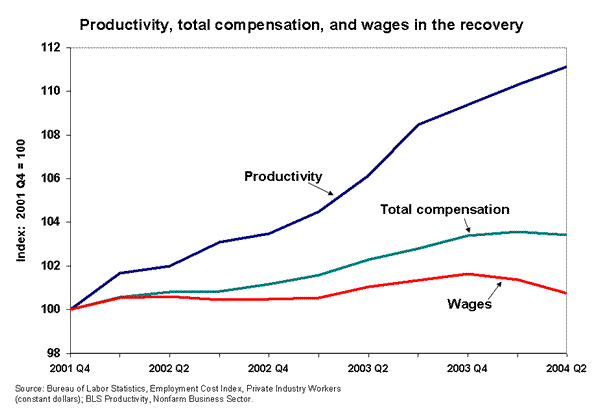
Yes, it is. Unfortunately workers sometimes get the short end of the stick in capitalism. They don't call it workism, you know. People can work hard for a living and achieve success and still not receive commensurate rewards. Those high corporate productivity levels didn't occur by paying people what they are worth.


So how will Krikorian process this discrepancy? Will he attempt to discover the reason? Will he be moved to empathize with the plight of the working man? Or will he deny and make up a bullshit reason to ignore facts?

It seems like there’d have to be bonuses and incentives and the like that the reporter was too incurious to ask about.
Denial it is. But denial isn't always enough. There must be someone to blame for the ills of the world, someone...different.

But in a profile of this particular dot on the fast-food map you have to read carefully to discern what happened when the store was purchased in 2003 by Cuban-born Carlos Mateos — namely, that the black Americans were fired and replaced with Hispanic immigrant workers, virtually of them originally illegal aliens now claiming to have temporary status[.]

[snipped quote]

[snipped boilerplate liberal sniping]

Finally, I know some readers will draw immigration-policy lessons from Reyes’s having to fire the American workers who were “giving away free food” and “taking money from the cash register” — namely, that we need the infusion of values that mass immigration brings because our own people (and let’s face it, it’s our black people everyone’s thinking of when they say this) are irredeemably indolent and depraved.

"Our" black people are "irredeemably indolent and depraved." Nice. You have wonder what kind of loathsome need is satisfied by such ugly hatred and contempt.

Mark Krikorian is a racist pig. He fits right in at The Corner as part of National Review's long, long history of blatant racist piggery.

"The central question that emerges . . . is whether the White community in the South is entitled to take such measures as are necessary to prevail, politically and culturally, in areas in which it does not prevail numerically? The sobering answer is Yes–the White community is so entitled because, for the time being, it is the advanced race. It is not easy, and it is unpleasant, to adduce statistics evidencing the cultural superiority of White over Negro: but it is a fact that obtrudes, one that cannot be hidden by ever-so-busy egalitarians and anthropologists.
National Review is still publishing the work of racist pigs such as Krikorian and John Derbyshire, who said:

Our species separated into two parts 50, 60, or 70 thousand years ago, depending on which paleoanthropologist you ask. One part remained in Africa, the ancestral homeland. The other crossed into Southwest Asia, then split, and re-split, and re-split, until there were human populations living in near-total reproductive isolation from each other in all parts of the world. This went on for hundreds of generations, causing the divergences we see today. Different physical types, as well as differences in behavior, intelligence, and personality, are exactly what one would expect to observe when scrutinizing these divergent populations.

Now, the empirical grounds. We all notice the different physical specialties of the different races in the Olympic Games. There was a run of, I think, seven Olympics in which every one of the finalists in the men’s 100 meters sprint was of West African ancestry — 56 out of 56 finalists. You get less pronounced but similar patterns in other sports — East African distance runners, Northeast Asian divers, and so on. These differences even show up within sports, where a team sport calls for highly differentiated abilities in team members — football being the obvious example.

...

We see the same differences in traits that we don’t think of as directly physical, what evolutionary psychologists sometimes refer to as the “BIP” traits — behavior, intelligence, and personality. Two of the hardest-to-ignore manifestations here are the extraordinary differentials in criminality between white Americans and African Americans, and the persistent gaps in scores when tests of cognitive ability are given to large population samples.

The National Review is filled with the mentally indolent and the morally vacuous, all brought together to persuade the world that conservatism is a respectable political party instead of a grab-bag of losers united by their fantasies of racial and cultural superiority. They want total control over their fellow man because that is the only way to force everyone else to acknowledge their superiority and give them the extreme deference and respect that their thwarted souls crave.

From Wikipedia:

Krikorian frequently testifies before Congress and has published articles in The Washington Post, The New York Times, Commentary, National Review, and elsewhere.[vague] He has appeared on 60 Minutes, Nightline, the NewsHour with Jim Lehrer, CNN, National Public Radio and many other television and radio programs.
Our liberal media, ladies and gentlemen.


spelling corrected

Monday, September 5, 2011

Reap, Sow


I, too, hope Conservative Daddy raises his son to be just like him. When the government is finished helping the financial elite bleed Social Security to death and C'Daddy needs to move in with his son, his son will probably tell Dad that he should have saved for his old age and he's on his own.

Sunday, September 4, 2011

Wool Over Their Eyes

From GoComics


"For together we are strong." What are the sheep going to do, nibble him to death?

We don't need to find the right farmer, we need to find killer sheep.


See also

Wednesday, August 31, 2011

Laws Are For The Little People

Once upon a time (Oct. 20, 2010), Princess Megan McArdle decided to exhibit a twinge of regret.

So having finally closed on the house, we're living in what is euphemistically known as a "mixed" neighborhood, where poor black residents who have lived there for a generation or more exist somewhat uncomfortably side-by-side with more affluent whites who are drawn to the relatively cheap rents and lovely Victorian housing stock. The tensions thus built up are played out in many places, notably local politics, where a recent attempt by a local cafe to get a liquor license triggered many of the arguments that we heard after Adrian Fenty's loss in the mayoral race.

Yesterday, I rode the bus for the first time from the stop near my house, and ended up chatting with a lifelong neighborhood resident who has just moved to Arizona, and was back visiting family. We talked about the vagaries of the city bus system, and then after a pause, he said, "You know, you may have heard us talking about you people, how we don't want you here. A lot of people are saying you all are taking the city from us. Way I feel is, you don't own a city." He paused and looked around the admittedly somewhat seedy street corner. "Besides, look what we did with it. We had it for forty years, and look what we did with it!"
As related here, the blogosphere collectively coughed bullshit! in response. McArdle went on (and on and on) to say that while it was regrettable that the black middle class was pushed or moved further from the city's center, it was either her or them.

I didn't know quite what to say. It's true that for a variety of historical reasons--most prominently, the 1968 riots that devastated large swathes of historically black DC--our neighborhood has more in the way of abandoned buildings than retail. And I'm hardly going to endorse the gang violence about which he presently discoursed at length. But the reason we moved into our neighborhood is that we want to live in a place that's affordable, and economically and racially mixed. We don't want to take the city from them; we just want to live there too. Perhaps I should have said that.

Oh, I'm quite sure that there are white people who are impatiently waiting for all the black residents to be forced out (except for the affluent ones), just as a few neighborhood old timers have been known to throw bottles at hipsters. But at least in my hearing, that has been far from a majority sentiment, on either side. It seems as if there ought to be some way to make it work.

But then, I am largely in agreement with a perceptive essay by Benjamin Schwartz that appeared in our pages a few months ago, arguing that the neighborhood I want to live in doesn't exist--or at least not for long:

[snipped quote]

When I say I'm in agreement, I mean empirically, not philosophically. I watched the process in the mixed-income neighborhood I grew up in, which was liberally dotted with housing projects, old tenements, and lots and lots of stores that served poor people. Eventually, only the housing projects were left, marooned on little islands amid a tidal wave of affluence that had even swept the residents out of the seventh-floor walk-ups built when Victoria was still on the British throne. There was virtually nowhere for the residents of the housing projects to shop or eat, as all the markets and restaurants had at least doubled in (real) price and changed their mix of goods to cater to investment bankers, not single mothers making $28,000 a year. The financial crisis temporarily halted the process, leaving some lower-income retail on Amsterdam Avenue. But I'm sure that as Wall Street gets its groove back, that too will go.

I have no idea how you could stop this process. To keep our neighborhoods the way Jacobs and I liked them would involve massive coercion not just of real estate owners, but of merchants, food vendors . . . everyone in the network of service providers that supports a neighborhood. The more people like me who move into my current neighborhood, the more services the neighborhood will attract--and those, in turn, will bring further waves of gentrifiers who will use their higher incomes to drive up rents, home prices, and the assessed values upon which property taxes are based.

I want the services, but I don't want this to price out all the people who already live there. Unfortunately, it's a package deal.

As proof of her desire to retain some of the more modest characteristics of her new neighborhood, McArdle is now irate that a "gastropub," a gourmet bar and restaurant, is unable to open its doors close enough to her so she can walk home after becoming inebriated.

The residents of my neighborhood have been very excited to watch construction progress being made on Shaw's Tavern, a gastropub located at the intersection of Florida Avenue NW and 6th street. There aren't a lot of sit-down dining options in the area--a couple of Thai places, a bar and a bar/coffee shop, and one kebab place with great kebabs but glacial service and no atmosphere. Don't get me wrong--residents are grateful for even this small number, given that it is approximately 400% more places to eat than we had a few years ago. But we are still eager for a restaurant where you can sit down and order a drink and a full meal, all at one time.

The funny part is that as soon as McArdle has children she will become irate that she is surrounded by neighborhood bars, with their traffic, street urination and noisy fights, loud music, and ear-piercing shrieking constant laughter, as their liquored-up denzions indulge in their God-given right to drink in public.

Then Shaw's Tavern opened, and the excitement fizzled. There was a hold up on the liquor license, due to two charity events that the tavern had held prior to securing their liquor license. Apparently, they had failed to get the special one-day liquor license that DC requires for people without a permanent license to serve booze; allegedly, the manager (now fired) forged documents to get liquor distributors to provide him with booze. At first, the delay was only supposed to be for a week; then we were told that the restaurant wouldn't be serving booze until at least September 15th, when the Alcoholic Beverage Regulation Administration meets again.

Well, that was stupid, as well as dishonest. They couldn't bother to get a liquor license, a fundamental requirement for a bar? It's like not getting a building permit for remodeling or a dba. It's a major, major error. And then committing fraud to cover up the bad decision just reveals the lack of judgement and morals of the pub's owners and staff. They could have bought some time and covered their asses by getting the one-day permit but wouldn't even do that. But instead of taking into account the actions of the owner(s) and the law of consequences, McArdle's knee jerks and kicks the nearest government office.

Unfortunately, there are few dry Baptists living in the Bloomingdale/Eckington/Ledroit triangle; most people who want a meal, want to be able to get a drink to go with it. On Friday, Shaw's announced via Facebook that they would be shutting down until they get their liquor license:

Shaw's Tavern is closing its doors from Saturday 27th of August. We could not survive without a liquor license. We will re -open when we are allowed to serve alcohol. To all of our 936 plus loyal fans and 30 dedicated employees, we thank you for your amazing support and understanding.

Unfortunately, this may well be a death sentence. Despite the lack of competition on the fine-dining front, the restaurant was at best operating at 60% capacity most days. The longer this stretches out, the less likely it is that they'll be able to reopen: the chef will have to get another job, the servers will go elsewhere. As Matt Yglesias notes, in DC

There's plenty of demand for bars and restaurants. There's plenty of space where bars and restaurants could open. There are plenty of people who need jobs. What's more, there are plenty of people who could use the increased social services that higher tax revenue would provide. Instead, we're doing this. Not just one restaurant shut down, but a sign to would-be entrepreneurs everywhere that their potential investments are much riskier than a superficial read of market conditions would suggest.

Damn you regulations, that won't permit people to serve alcohol to the public without following strict rules! How are entrepreneurs supposed to entrepreneur if they are required to follow silly rules? Or laws and regulations aimed at maintaining a safe environment for the neighborhood's residents? Surely McArdle would be thrilled if noise regulations vanished? Traffic laws? Or maybe just the rules that happened to inconvenience her at any given moment. She can keep the noise and traffic laws since they benefit her but jettison the alcohol laws since they momentarily inconvenience her.

When a number of us lamented the shutdown on Twitter, we were met with people saying, in effect, that ABRA had to send a strong signal about following the rules. I don't condone forging documents, if this indeed occurred. But I don't see why ABRA has to send this particular signal about following the rules--or what terrible harms would follow if they didn't.

Now, you must admit that McArdle is just being fair here. If she didn't care that mortgage companies and banks were forging documents, why should she care if one little old restaurant was forging documents?

A couple of commenters mention that the government (meaning Americans) want liquor laws to prevent underage drinking. They must not realize that the Pensylvania Liquor Board had the nerve to implement underage drinking laws when McArdle wanted to drink while underage and arrested and fined her, putting her through multiple inconviences. To make matters worse, McArdle ignored some of the provisions of her release and never sent in the paperwork regarding the suspension of her (then hypothetical) driver's license, and so had to clear up the matter years later.

At the age of nineteen, way back in 1992, I purchased a beer in a Philadelphia bar.

No, I hear you cry, it cannot be true! I know, readers. You are hurt. You are shocked. You never thought I could be capable of such depravity. Well, frankly, I didn't either. Little did I suspect when I bundled off to the University of Pennsylvania in the fall of 1990 that I had stumbled into a den of iniquity where underaged drinking sometimes took place.

I cannot excuse it. I allowed myself to be led astray. Yes, one sultry July evening, I allowed myself to be persuaded--by a malefactor or malefactors who shall remain nameless--to enter one Murphy's Tavern on 45th and Spruce and purchase, to quench my thirst, a Rolling Rock.

Not that! Nay, never that! Believe me, your wailing and gnashing of teeth wounds me as deeply as it wounds you. In my defense, I can only say that I had no idea PBR was going to win the hipster coolness wars.

While consuming my one (1) beer, I was apprehended by agents of the Pennsylvania Liquor Control Board. They called my parents, fined me, and made me attend a class on the horrors of underaged drinking (did you realize that drinking can lead to uncontrollable vomiting?) It was during that class, with the errors of my ways now readily apparent, that I made a pledge to myself to quit underaged drinking with all due speed. And on January 29th, 1994, I honored that pledge.

The government paid no attention at all to McArdle's wants and needs. They just got in her way! Don't they know that rules are for other people? That underage drinking is bad when other people do it but it's just fine when Ivy League students do it? That punishments are for other people who do bad things, not for nice, white, college students who went to expensive prep schools?

Now for the painless segue from idiotic bureaucratic snafu to moral: this just goes to show why ironclad bureaucratic rules are such a bad idea. The federal law is meant to protect dangerous drivers whose licenses have been suspended from getting a license in another state--an excellent program. It is not, or so I mote, intended to allow the Commonwealth of Pennsylvania to suspend my license for an underaged drinking conviction that took place 16 years ago. Indeed, I don't think that even the Commonwealth of Pennsylvania law was intended to do something so moronic--it isn't as if I deliberately (or even accidentally) failed to comply; I simply didn't have a driver's license for them to confiscate. Since I didn't get one until I was well over the legal drinking age, I'm pretty sure that a moment's consideration would lead any reasonable bureaucrat to dismiss this idiocy.

But of course, we don't have reasonable bureaucrats. We have rules. Rules that Must Be Followed No Matter What. Neither Pennsylvania nor DC can, apparently, do anything at all to prevent the Wheels of Justice from punishing me for a long-past transgression that did not even involve a motor vehicle.

Damn you again, rules! Any reasonable person would have let a important person of quality like McArdle off with a wink and a nod, like in the good old days. Now everyone is supposed to follow the rules, even the upper class! And it's all the fault of those stupid, useless liquor laws.

Punishing a restaurant owner for a liquor license violation with an open-ended maybe-we'll-give-you-a-license-maybe-we-won't delay is equivalent to giving someone the death penalty for a parking violation. Moreover, it punishes the neighbors and the employees right along with the owner.

There should be special rules for Friends Of McArdle, thank you very much.

I've seen commenters and others suggesting that if they would forge liquor license paperwork, they might fake the health inspection data or other information. But does this really follow? The regulation in question is, not to put too fine a point on it, anti-competitive BS.

Note the Randian dog-whistle, from the woman formerly named Jane Galt who in no way, shape or form is a Randian.

We wanted to get a friend to bartend for our wedding in order to save money (and have a friend bartend our wedding!), but doing so would have required us to get a one-day liquor license, as well as to buy the liquor from an authorized DC liquor distributor. The cost of the license and the expensive DC booze would have ultimately cost us as much, or more, than using a caterer--which I've no doubt is exactly the point. This is pretty clearly rent seeking designed to protect caterers and local liquor distributors from competition, not a service to the citizens of DC, who might otherwise be served out-of-state poison at weddings.
You will not be surprised to see that McArdle changes the goalposts on this story when confronted with facts, or that her facts are wrong. From the comments:

Robert Rutledge 21 hours ago
Are you kidding? Look, I'm a Truxton Circle resident who was really looking forward to Shaw's -- and a liquor rep who was really looking forward to selling to them -- but these accusations are not insignificant. Regardless of how you feel about regulation in general, forging an ABRA license shows a HUGE lack of integrity and foresight. Not only were they putting themselves in danger here (which is now obvious), but the distributors they fleeced could also have been in deep trouble, even though they did their due diligence.
I find their claim that this was ALL Steve May's doing to be highly dubious, and am not shedding a tear for the owner. Incidentally, he closed the place down on Friday with no warning to the staff, five minutes before service, and the chef quit in protest.

Oh, and incidentally, a one-day ABRA permit is like a hundred bucks, and DC distributor prices are WELL below retail, or what a caterer is likely to charge you. If you actually put the effort in, it can actually be a good deal cheaper to cater one's own event.

McMegan 17 hours ago in reply to Robert Rutledge
When I looked into it, it was more like $500-700, and I would have needed to hire at least a couple of pourers to help my friend since we had more than 100 guests. When we ran the numbers, it would have cost the same or more. We gave up and went with an all-inclusive venue. I know when you're running a business, saving $500 may seem trivial, but it was big money for us--which is presumably why the fee is so high, to prevent people from cheaping out.

And while the distributor prices here may be cheaper than retail, they were not cheaper than the prices that we could have gotten by getting our friend to bring liquor from a cheaper state. Which is what we would have done, except that DC's licensing regime prevented us from doing so. I'm sure this is great for DC liquor distributors, but it's pretty hard to argue that DC residents need to be protected from dangerous out-of-state hooch.

RobertVonRankeGraves 14 hours ago in reply to McMegan
As ever, Megan, you lie like a carpet remnant.

The fee for a class F beer and wine event license is laid out in DC Regulations 23-208.12: $130/day.
The fee for a class G beer wine and spirits license is also there: $300/day.

Considering the potentially large cost externalities of public alcohol consumption, including law enforcement expenses and personal injury and property damages in tort, a little fee as a practical bar to casual beer blasts seems like a good idea to limit social costs from excessive alcohol consumption and to ensure that event planners take the consequences of alcohol consumption seriously.

McMegan 2 hours ago in reply to RobertVonRankeGraves
Yes, but I had to get the license through a caterer in order to get the caterer to work with me, and they charged $500-700. Perhaps I could have threatened them with legal action, but I don't really want someone preparing my food under threat of lawsuit.
Flag Like ReplyReply

Or McArdle could have put the free market to work and found a caterer who would accept the arrangement, but she chose to not do so.

In my humble opinion, in fact, all liquor licensing is useless; it mainly functions as either backdoor zoning control, or as a way for existing bar owners to protect themselves from competition. But this rule is particularly egregious.

No, it isn't. You forge liquor permits, you lose liquor permits.

If you find out that someone you know parks illegally in their alley, do you really think that it's a short step to murdering their neighbors?

She does love her non-sequiturs.

Health regulations have an obvious rationale that liquor licensing lacks, and there are also clear financial downsides to violating them openly (customers do not like seeing vermin running around your restaurant, or eating spoiled food.) They're also vulnerable to detection on visual inspection: expired packaged goods or rat droppings will be seen by inspectors. Obviously, most restaurants do violate health regulations in small ways, and some do so flagrantly.

Actually, most don't. I waitressed for years and every restaurant was a stickler regarding health regulations. They had no desire to get shut down and end up on the local nightly news. The wait staff and kitchen staff all cleaned their areas daily and a cleaning company came in to handle the heavy or specialized work.

But I'm not sure how closely that's correlated to . . . soft opening with unlicensed charity gigs, even with dodgy paperwork.

Once again, fraud=dodgy paperwork. Her sense of morality and legality leave a lot to be desired.

At any rate, the manager who allegedly did these things has been fired, and the owners have already lost a lot of money. This seems like adequate punishment. It's hard for me to believe that ABRA needs to kill viable establishments in an area that badly needs them, in order to save us from the scourge of . . . unlicensed cocktail parties. It seems widely out of proportion to the potential harm.

So what if the owners were incompetent and dishonest? McArdle wants a gastropub and she wants it now, goddammit! A commenter remonstrates McArdle:

The people opening the bar in your neighborhood presumably knew all of this and still went ahead with the investment. The fact that they had so much riding on this license makes their failure to properly supervise this 'rogue' manager all the more astonishing. A competent businessperson would have familiarized themselves with the reality of the regulatory environment, recognized the high stakes of this license, and made sure that they did absolutely everything in their power to secure it. This was indeed a life or death situation, but the owners seem to have mistaken it for a parking ticket dispute.

It's not like the board made an arbitrary or surprising ruling here: "we don't like your face, so you can't do business in DC." And It's not like the tavern did everything right but forgot to dot the "i" on a form or something. Maybe other restaurants are denied their license for bogus reasons. But that's not the case here. If the forgery thing is true, they flagrantly broke a law directly related to their liquor license application (!). How should the board have responded to the forgery of their own documents? There's no way any responsible regulator could approve a license immediately after that. So the tavern had to fire the manager and wait until the next meeting (or should the board scheduled a special session to expedite this errant restaurant's request?). If you want to help reform the liquor license process, you should describe an example where a business was denied a license for a more arbitrary or corrupt reason. If, as you say, there are stories of gross incompetence or unexplained delays (or bribes) then tell those. That will generate momentum for reform more than the story of a business that genuinely screwed up.

Yes, it is very difficult to understand why McArdle is getting worked up over an unsuccessful restaurant, considering the circumstances. Yet another commenter:

cbar1980 21 hours ago
The author glosses over and omits some pretty salient points in order to fit the narrative she wants to believe. This establishment is one of two the same owner is trying to open within the same neighborhood, the other being an "Engine 12" restaurant. The other concept's construction has been shut down numerous times for failure to obtain building permits, and is embroiled in a similar liquor license ordeal - much of it their own making. In the case of Shaw's Tavern, they opened without a license, without a Certificate of Occupancy, forged their liquor license for both government inspectors and the wholesale companies. When caught red-handed, they then embarked on a PR campaign decrying the oppressive, anti-business slant of the DC government.

If they followed the rules which are in place for a reason, they'd probably have a license right now. The rules which the author finds so onerous, are the same ones that prohibit an illegal club from opening up next door to her in a residential neighborhood - legally speaking, what here upscale gastropub did is no different than such an operation. The owner of the business has demonstrated a track record for obviating the laws, and may not fit the suitability criterion for owning a liquor license(which honestly is not a high bar in DC).

The world needs ditchdiggers too, and just because someone wants to open a restaurant, doesn't mean their qualified - similarly, just because someone writes a blog, it doesn't mean that they're also well-informed.

RustBeltModerate 20 hours ago in reply to cbar1980
Written like a person who has never built anything or operated a business.

McMegan 18 hours ago in reply to cbar1980
Actually, no. The zoning regulations are what prevents an illegal pub from opening up next to me . . . but being a libertarian, I frown on the notion of illegal pubs.

Actually, not always. In this case, lack of a liquor license prevented an illegal pub from oopening next to her. McArdle seems to think that the restaurant just made an oopsie, but forgery is a deliberate decision and serious business. Why didn't the pub's owner just get the license?

McMegan 3 hours ago in reply to thomasrhys
In order to make it as a restaurant with no alchohol, you need to serve extremely cheap food that can be produced in volume. There are very few fine dining establishments that thrive without it--probably Kosher places get by with thin liquor sales (but their food is more expensive for the quality you get), and maybe places in Mormon areas. But in most places, above the level of cheap-and-cheerful fried-things-with-carbohydrates places, no booze, you lose.

Which makes that decision to ignore the liquor license a spectacularly bad business decision, and it is no surprise that the people who made it lost their restaurant.

Monday, August 29, 2011

Mysteries Of The Universe


People always have a reason for their actions; it might be trivial or deeply buried but it always exists. Perhaps their choice flatters the ego, hides a fault or mistakes, advances an agenda, eases anxiety, or merely gives a moment of pleasure. Whatever the motivation, people make choices and decisions based on needs, wants and fears. Illogical and self-harming actions are only inexplicable to those who do not know the individual's motivation.

Megan McArdle announces Alan Krueger appointment to the president's Council of Economic Advisers and gives him her tentative approval. In the past, McArdle has spoken out against almost everything Krueger has supported and it's a little difficult to understand why McArdle is making one of her rare diversions from the economic elite's dogma.

It's also no bad thing that we have a labor economist at the CEA right now, when our failure to create jobs for the standing army of the unemployed is by far our biggest problem. It's not that I think there's some magical program for re-employing everyone that has been hitherto overlooked because the CEA didn't have Alan Krueger on hand (I'm sure Austan Goolsbee could--and did--get him on the phone any time he wanted.) But on the margin, it matters that someone who has spent much of his career studying labor market outcomes will be dedicating the next few years to helping the president devise economic policy. When issues come up, his mind will naturally see the repercussion for jobs. And that's exactly the focus we should have right now.
Krueger is a labor economist, which automatically would put him on the wrong side of the indivisible line between labor (boo!) and capital (yay!) that McArdle has erected in her brain. She disliked the cash for clunkers program, which Kruegar worked on, and has spoken dismissively of supporters of increasing the minimum wage, saying they are confined to "movement think tanks" and "marginal academics." Kruger co-wrote a well-known study that showed increasing minimum wage did not increase unemployment.

We only have one or two small clues that might help us solve the riddle of the inner workings of McArdle's brain.

On other fronts, I think Krueger is an excellent choice. I've heard him speak in a number of off-the-record sessions, and I don't think that anyone is going to be mad at me for revealing that he was extremely impressive, with a grasp of labor market economics that seems to this non-economist both encyclopedic, and very nuanced. He's also very good at explaining those distinctions in a way that makes sense.
Perhaps McArdle merely parroted the thumbs-up that Tyler Cowen gave Krueger. Or maybe it's just that McArdle is a sucker for power, and if she has basked in the glow of an important person she is theirs forever. Austan Goolesbee is far too liberal for McArdle's acceptance under ordinary circumstances but she was a student of his and knowing that she has been that close to power is utterly intoxicating to her. One cocktail party convinced her that David Koch was a rilly great man who never could have done something so underhanded as to bankroll and organize the supposed grass-root tea parties.

We will probably find out the reason in due time, as McArdle's commenters take to the inadvertent bait like sharks to chum, irate that she would support an Obama hire when everyone knows that the best government is no government (at least in between hurricane recovery and relief efforts).

Saturday, August 27, 2011

Going Galt


Because nothing says rugged libertarian individualism and pulling your own weight like standing in line for federal government giveaways.